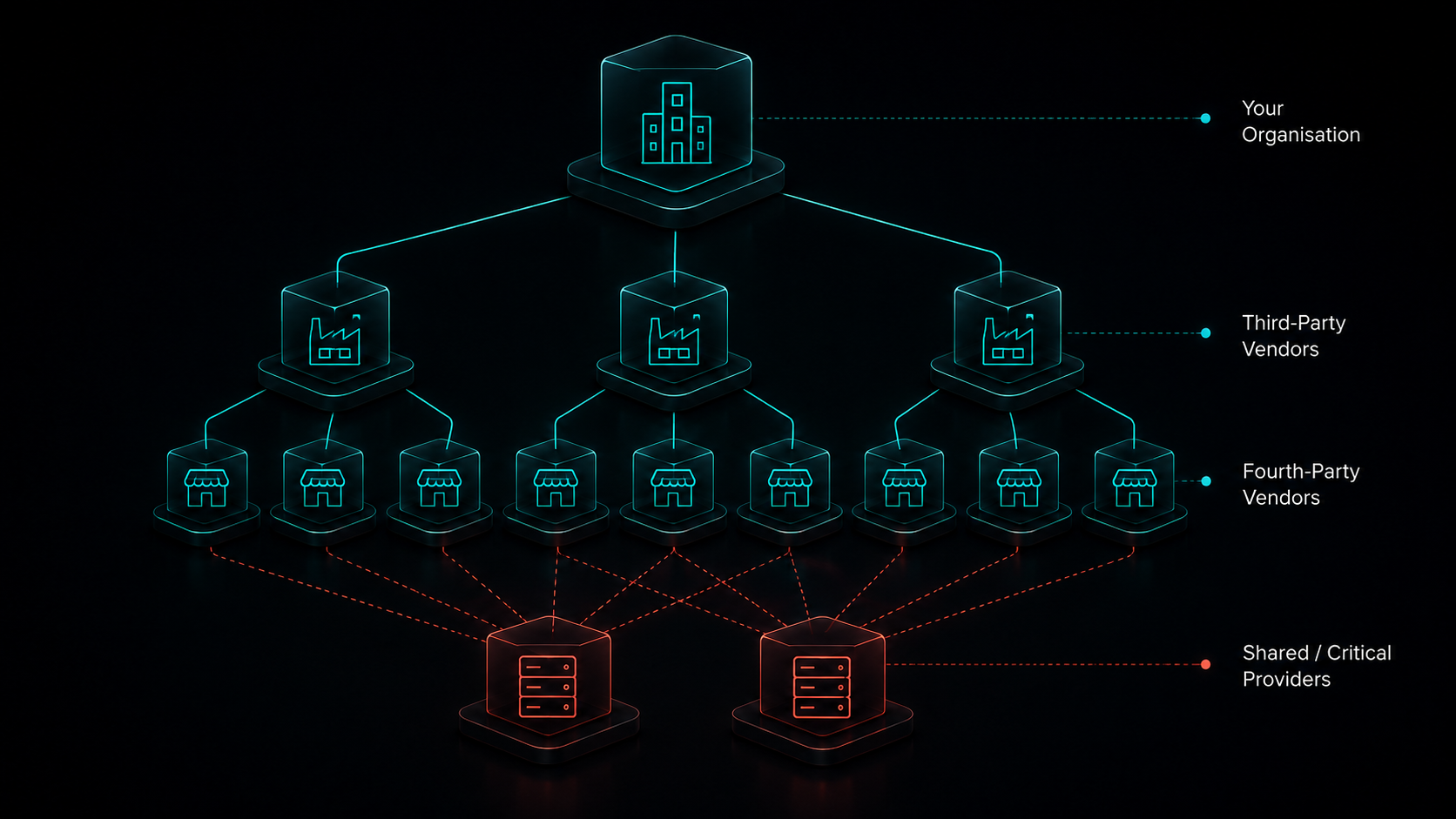
October 9, 2026
・
23
mins read
.png)
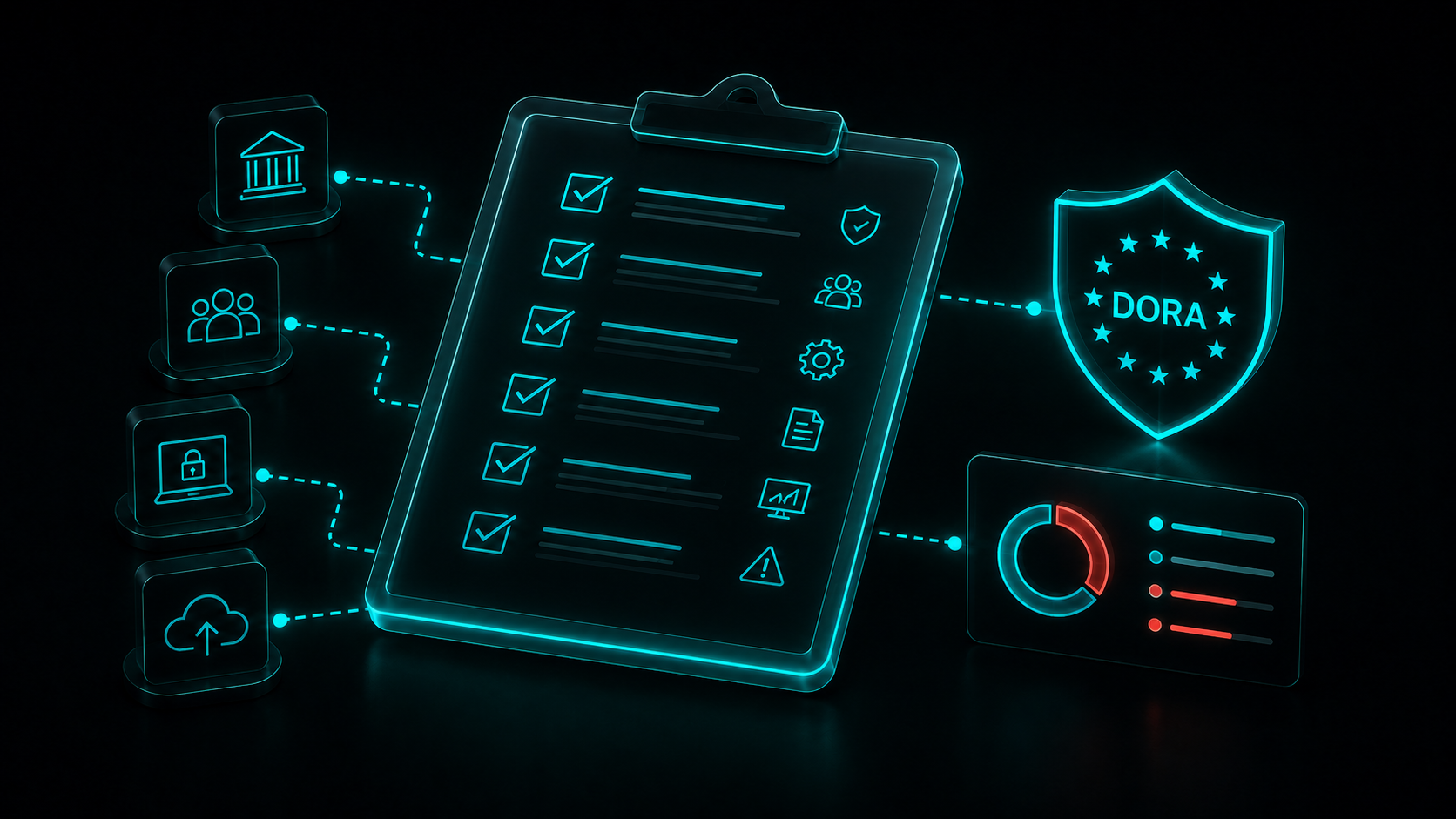
This guide builds on foundational research from The Digital Operational Resilience Act (DORA): A Comprehensive Guide to TPRM Compliance, co-authored by Evelyn Partners, Emily Hodges and Chris Luenen (Risk Ledger), updated here to reflect DORA's first enforcement cycle. Examples in this guide are drawn from real engagements. Identifying details have been changed to protect client confidentiality.
DORA has applied since 17 January 2025. For financial services firms today, the challenge is no longer understanding what the regulation says. It’s proving that ICT risk, supplier dependencies, incident reporting, resilience testing and exit plans are operationally ready.
In this guide, we’ll map the main DORA obligations to the controls financial services teams need to operate, the evidence they should retain, and the legal references that matter - including Article 30 contractual provisions, the Register of Information, major ICT incident reporting, TLPT, subcontracting and fourth-party risk.
If a critical ICT supplier failed tomorrow, could you explain which services would be affected, which dependencies matter, what evidence supports the risk decision, and how the business would continue operating?
A programme that can only answer “we reviewed the supplier” is only really compliant on paper, a programme that can answer the dependency, incident, testing and exit questions is much closer to being resilient in practice.
DORA compliance in 2026 is best understood as an evidence and operating-model challenge, not a policy-writing exercise.
Financial services firms need to show that they can:
The hardest items aren’t the ones that produce the most documents, they’re the ones that require you to connect information across teams, suppliers and systems: concentration risk, subcontracting, incident readiness, exit planning and continuous monitoring.
That is where many DORA programmes remain weakest. Supplier evidence may exist, contracts may have been reviewed, but if you can’t quickly answer how a supplier failure would affect critical services or whether two backup providers share the same fourth party, the programme is still only partially tested.
This checklist is written for financial services teams responsible for turning DORA from regulatory text into an auditable operating model.
That includes:
It’s also useful for ICT suppliers serving financial services customers. DORA may not make every supplier directly regulated, but it changes what regulated customers will ask for in due diligence, contracts, incident response, subcontracting and ongoing monitoring.
DORA became applicable on 17 January 2025.
Before application, many firms were asking: What is DORA? Are we in scope? Which policies and contracts need updating? What needs to be ready by the deadline?
In 2026, the questions are now:
This is the practical difference between having a DORA programme and having one that actually holds under pressure.
DORA applies directly to a defined set of financial entities in the EU financial sector. These include, among others, credit institutions, payment institutions, electronic money institutions, investment firms, crypto-asset service providers, central securities depositories, central counterparties, trading venues, insurance and reinsurance undertakings, insurance intermediaries, institutions for occupational retirement provision, credit rating agencies and crowdfunding service providers.
DORA also affects ICT third-party service providers because regulated financial entities must manage supplier risk through due diligence, contractual provisions, monitoring, incident response, exit planning and reporting.
A cloud provider, software vendor, data processor, managed service provider or infrastructure supplier may therefore receive DORA-specific requirements through its financial services customers, even where the supplier is not itself a financial entity.
A smaller group of ICT providers can be designated by the European Supervisory Authorities as critical ICT third-party providers. These providers are subject to direct EU oversight because of their systemic importance to the financial sector.
That designation doesn’t transfer responsibility away from financial entities. Firms still need to understand where they rely on those providers, how substitutable the services are, and what happens if the provider or a supporting dependency fails.
For UK firms, DORA should be treated carefully. UK-regulated firms are not automatically subject to DORA simply because the UK has similar operational resilience expectations. But DORA may still matter directly or commercially where a UK firm has EU-regulated entities, serves EU financial entities, belongs to a group with EU operations, or provides ICT services into the EU financial sector.
DORA is commonly described through five pillars:
For implementation teams, the pillars should not be treated as five disconnected workstreams, they interact.
A Register of Information is not just an inventory, it should support incident response, concentration risk analysis, resilience testing and regulatory reporting.
An Article 30 contract is not just a legal document, it should support audit rights, incident assistance, subcontracting controls and exit.
And a resilience test is not just a technical exercise, it should validate whether critical services can continue when ICT suppliers or shared dependencies fail.
The common mistake is to build DORA around documents rather than decisions. Policies, registers and contracts are necessary, but they are only useful if they help you answer operational questions under pressure.
Each item should be assessed in five ways:
The firm needs to confirm which legal entities, regulated activities and ICT arrangements are in scope under DORA.
Create a scope assessment covering:
Regulation (EU) 2022/2554, Article 2.
Ask: If a regulator or board member asked why a specific entity, service or supplier is in or out of scope, could you explain the reasoning and show who approved it?
DORA places responsibility for ICT risk management at management-body level. The management body is expected to define, approve, oversee and periodically review the ICT risk management framework.
Make accountability visible in governance, not just policy wording. The firm should be able to show how ICT risk is escalated, reviewed and challenged.
Regulation (EU) 2022/2554, Article 5.
Ask: Could the management body explain your most material ICT third-party risks, the services affected, and the decisions made to accept, reduce or monitor those risks?
The firm needs an ICT risk management framework covering identification, protection and prevention, detection, response and recovery, learning and evolving, and communication.
Maintain a framework that connects ICT assets, services, controls, risks, incidents, suppliers and recovery arrangements.
Regulation (EU) 2022/2554, Articles 6–16; Delegated Regulation 2024/1774.
Ask: Can you quickly identify which ICT assets and suppliers support a critical or important function, and what controls protect them?
DORA expects financial entities to understand the ICT assets, systems and third-party services that support their business. For implementation, the key step is connecting ICT dependencies to the services and functions the business actually needs to keep running.
Map ICT assets and third-party services to:
The goal is not to create a perfect architecture diagram for every system. It is to understand which ICT dependencies matter most to operational resilience and regulatory obligations.
DORA’s ICT risk management and ICT third-party risk management requirements, including Articles 6-16 and Article 28.
Ask: If a critical service was disrupted, could you identify the supporting systems, suppliers, data flows and recovery owners quickly enough to support incident response and management-body reporting?
DORA requires financial entities to maintain a Register of Information covering contractual arrangements with ICT third-party service providers.
The Register of Information is more than a supplier list. It should help the firm understand which ICT services are provided, which entities and functions they support, whether they relate to critical or important functions, and what contractual and subcontracting dependencies exist.
Build and maintain a structured Register of Information that captures ICT third-party contractual arrangements at the right level of detail.
At minimum, the firm should be able to use the register to answer:
DORA Article 28 and the ESA / EBA Register of Information implementing technical standards and related guidance.
Ask: Does the register help you make decisions, or does it merely satisfy a reporting format?
A strong Register of Information should support incident response, concentration risk analysis, supplier monitoring, exit planning and supervisory requests. If the register cannot help answer which critical services depend on a given provider, it is probably not yet operationally useful.
DORA requires financial entities to establish a process to detect, manage and classify ICT-related incidents. Major ICT-related incidents must be reported to the relevant competent authority.
The practical challenge is not only having an incident response policy. It is having a classification process that works quickly when information is incomplete, especially when the incident starts with a supplier.
This process should be integrated with existing security operations, operational resilience, legal, compliance and supplier management workflows.
DORA Articles 17-18 and related regulatory technical standards on incident classification.
Ask: If a critical supplier reported an outage or breach at 09:00, could you decide whether it may be a major ICT-related incident, identify what information is missing, and escalate to the right decision-makers the same day?
DORA requires financial entities to report major ICT-related incidents through the prescribed reporting process. The reporting framework includes an initial notification, intermediate reporting and a final report.
For financial services firms, supplier-originated incidents are one of the hardest scenarios. The firm may be responsible for reporting, but the information needed to classify and explain the incident may sit with the supplier.
Prepare a reporting process that covers:
The incident playbook should define what information is needed from ICT suppliers, including:
DORA Articles 19-23 and Delegated Regulation 2025/301 on major ICT-related incident reporting.
Ask: Have you tested whether a supplier-originated incident can produce enough reliable information to support the initial notification and follow-up reporting process?
If the answer is “we assume suppliers will tell us”, the process is not yet tested.
DORA requires financial entities to establish, maintain and review a digital operational resilience testing programme. Testing should be risk-based, proportionate and designed to identify weaknesses in ICT systems, controls and processes.
The important point for third-party risk teams is that resilience testing should not stop at internal systems. If a critical or important function depends on ICT suppliers, the testing programme should account for those dependencies.
Build a testing programme that includes, where proportionate:
For supplier risk, the firm should test assumptions such as:
DORA Articles 24-25.
Ask: Does testing validate real business-service continuity, or only technical control performance?
A penetration test may show a system weakness. A supplier resilience test should show whether the business can keep operating when an ICT dependency fails.
DORA requires certain financial entities to carry out threat-led penetration testing, commonly referred to as TLPT. TLPT is not a universal requirement for every firm. It applies where the relevant criteria and supervisory expectations are met.
The risk in many checklists is that TLPT is presented as if every DORA-regulated entity must do it. A better approach is to document the applicability decision clearly.
Determine whether TLPT applies to the firm and, if so, plan the testing cycle and governance model.
The assessment should consider:
DORA Article 26 and the relevant regulatory technical standards on threat-led penetration testing.
Ask: Can you explain whether TLPT applies, why that decision was made, and how any required test would include the ICT services and third-party dependencies that matter most?
DORA requires financial entities to manage ICT third-party risk as an integral part of ICT risk management. This includes strategy, policy, due diligence, contractual arrangements, monitoring, concentration risk, exit planning and the Register of Information.
For financial services firms, this is one of the central implementation challenges. A supplier review process that only collects documents once a year is unlikely to provide enough visibility into changing risk.
Maintain an ICT third-party risk management framework covering the full supplier lifecycle:
The framework should distinguish between:
DORA Article 28.
Ask: Can you show why different suppliers receive different levels of scrutiny?
If supplier tiering is based mostly on spend or company size, it may miss the real DORA question: what happens to the business if this service fails?
DORA Article 30 sets out key contractual provisions for ICT third-party service arrangements. Contracts for ICT services supporting critical or important functions require enhanced attention.
The point is not simply to add a DORA clause to every contract. The contract needs to support operational resilience, incident response, auditability, subcontracting control and exit.
Review ICT supplier contracts against Article 30 requirements and remediate gaps.
A practical Article 30 review should check for:
DORA Article 30.
Ask: If a critical supplier had an incident tomorrow, would the contract give you the information, access, assistance and exit rights needed to respond?
A contract that looks compliant but cannot be used in an incident is not doing its job.
DORA requires firms to understand and manage ICT subcontracting risk, especially where ICT services support critical or important functions. Subcontracting matters because operational dependency often sits beyond the direct supplier.
A financial entity may contract with one ICT provider, but the service may rely on cloud infrastructure, managed service providers, software components, data centres, processors or other subcontractors further down the chain.
Create a proportionate subcontracting review process that identifies material subcontractors and assesses whether they affect:
The process should also define how suppliers notify the firm of material subcontracting changes.
DORA Article 28, Article 30 and Delegated Regulation 2025/532 on subcontracting ICT services supporting critical or important functions.
Ask: Could you identify which subcontractors matter to a critical ICT service, and whether a change in subcontractor would require review, approval or risk acceptance?
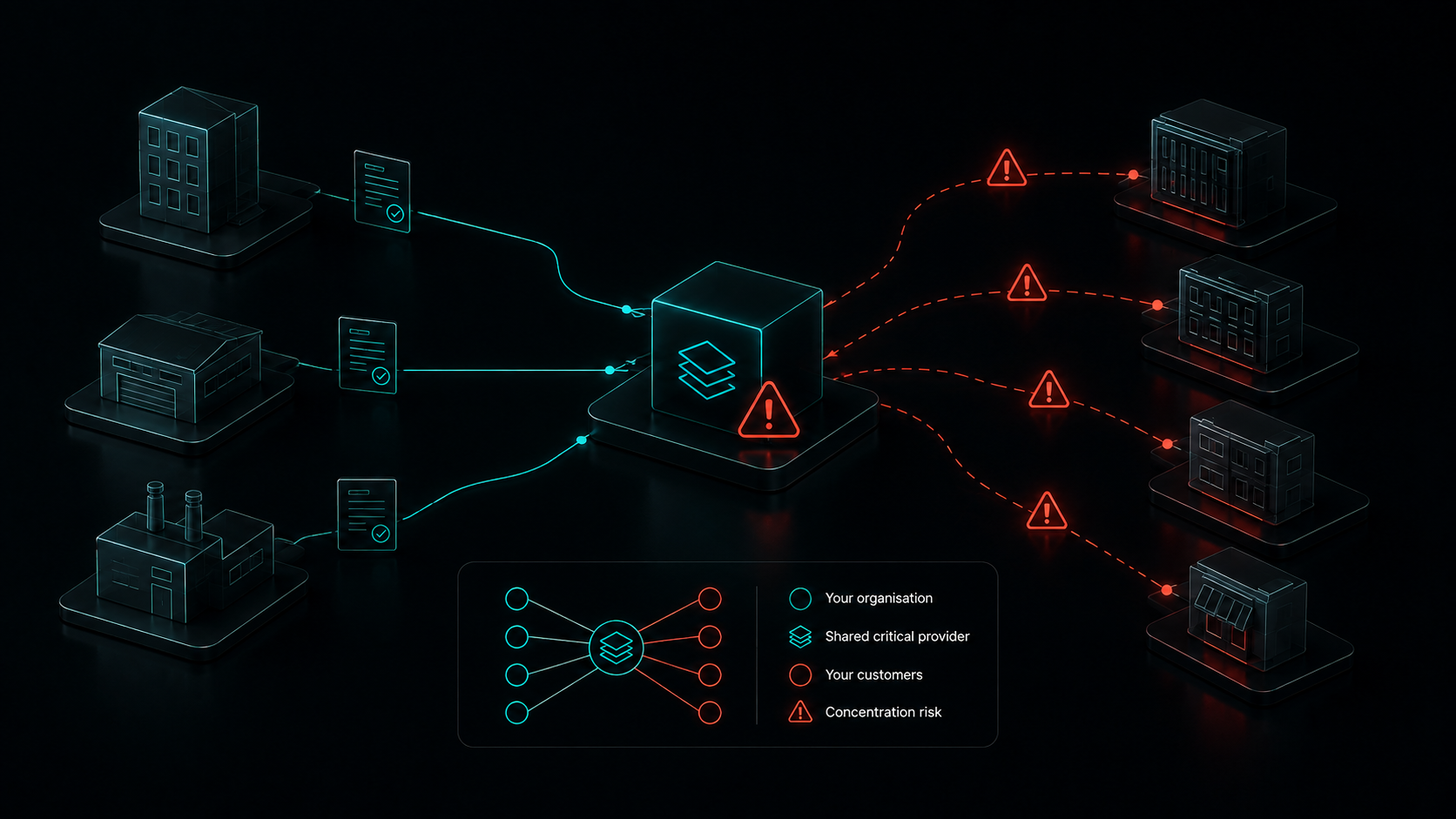
DORA requires financial entities to consider ICT concentration risk. In practice, this means understanding where multiple services, suppliers or fallback options depend on the same underlying provider, technology, geography or subcontractor.
This is one of the hardest DORA risks to identify because it rarely appears in a supplier-by-supplier assessment.
Map concentration risk across critical ICT services and suppliers.
Look for shared dependencies such as:
Then assess substitutability:
DORA Article 28 and ICT third-party risk management requirements.
Ask: if two “independent” suppliers both failed at the same time, could the firm tell whether they shared an underlying dependency?
This is where many paper-compliant programmes break down. A supplier questionnaire asks a supplier about itself. Concentration risk often only appears when the firm compares dependencies across suppliers.
DORA incident reporting and ICT third-party risk management depend on suppliers providing accurate information quickly when incidents occur. Contracts may define notification obligations, but readiness is only proven when the handoff is tested.
A supplier can have a good incident response plan. The financial entity can have one too. The gap appears when the two plans have never been introduced to each other.
For ICT suppliers supporting critical or important functions, test the incident handoff.
The test should cover:
This does not always need to be a full simulation. A tabletop exercise or structured contact test can expose major gaps.
DORA incident reporting requirements, Article 30 incident assistance provisions and Article 28 ICT third-party risk management requirements.
Ask: Have you tested whether the supplier can provide the information needed for DORA incident classification and reporting, or has it only written that expectation into a contract?
DORA requires firms to consider exit strategies for ICT third-party arrangements, especially where services support critical or important functions. Exit planning is not just a procurement exercise. It is an operational resilience question.
A named alternative supplier is not enough if the firm has not tested whether transition is possible within the disruption tolerance of the business service.
Maintain exit plans for ICT services supporting critical or important functions.
An exit plan should cover:
You should also test whether the plan is realistic.
DORA Article 28 and Article 30.
Ask: If the supplier had to be exited under stress, could you move the service, recover the data or operate a workaround within the time the business can tolerate?
If the answer is unclear, the exit plan is not yet tested.
The difference between a weak DORA programme and a strong one is often the quality of evidence. A policy may prove that a process exists. It does not prove the process works.
Use this matrix to test whether evidence is merely documentary or operationally useful.
Traditional supplier assurance looks at one supplier at a time. That’s useful, but it has a limit.
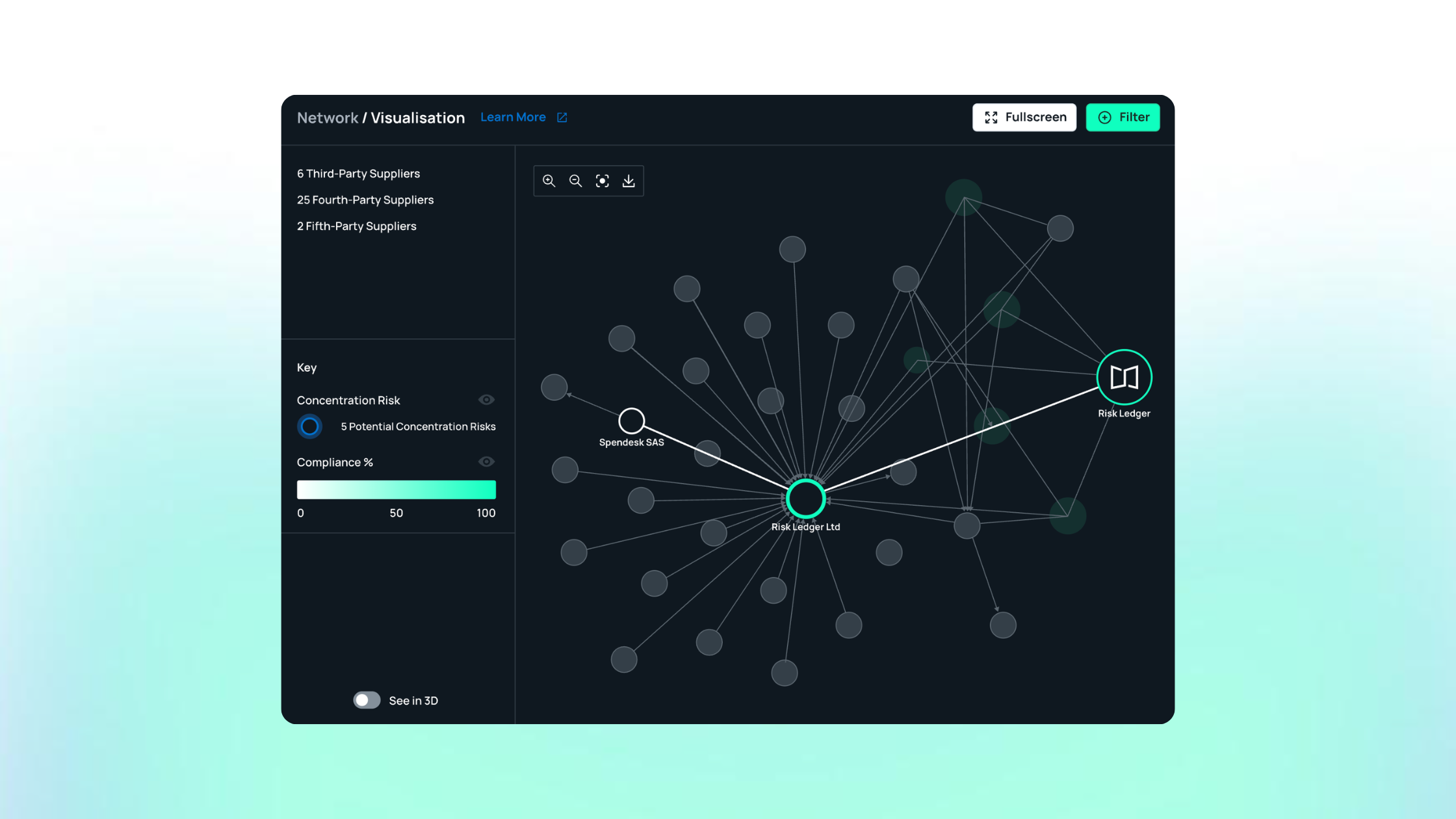
A supplier questionnaire can tell you whether a supplier has a security policy, incident response plan, certifications, access controls and backup process. It can’t easily show whether three different suppliers all rely on the same fourth party, cloud region or managed service provider.
That’s the concentration risk problem.
It also explains why repeated questionnaires create diminishing returns. Suppliers serving multiple financial services customers are often asked near-identical questions in different formats, on different cycles, by different teams. Over time, that leads to stale evidence, rushed answers and lower engagement.
The issue is not that questionnaires are useless. They remain necessary for collecting direct evidence from named suppliers. The problem is expecting one-off, supplier-by-supplier evidence collection to answer network-level questions.
DORA pushes firms toward questions that sit across supplier relationships:
Those questions need a more connected view of supplier risk.
DORA implementation is too broad to “finish” in 90 days. But a financial services firm can use 90 days to move from a document-led view to a more operational view of the suppliers and dependencies that matter most.
Focus on scope, ownership and prioritisation.
Actions:
Outputs:
Focus on the suppliers most likely to affect resilience.
Actions:
Outputs:
Focus on whether the programme works under pressure.
Actions:
Outputs:
The aim is not to make every supplier perfect. It is to prove that the firm understands the suppliers and dependencies that matter most, and that risk decisions are timely, documented and defensible.
Risk Ledger helps financial services teams manage the ICT third-party risk requirements that are hardest to sustain through manual, point-in-time assurance.
DORA increases the need for current supplier evidence, subcontracting visibility, concentration risk analysis and ongoing monitoring. But simply sending more questionnaires is not a sustainable answer. It increases supplier burden and often produces worse evidence over time.
Risk Ledger is designed around a different model.
Suppliers maintain one profile that can be shared with multiple customers. That reduces duplicate questionnaires and gives financial services teams more consistent, current evidence across the supplier base.
When suppliers are not forced to answer the same questions repeatedly in different formats, they are more likely to keep evidence current and engage properly with assurance requests.
A network model makes it easier to identify where suppliers converge on the same underlying providers, services or technologies. That helps firms spot hidden concentration risk that would not appear in a supplier-by-supplier review.
Supplier evidence can stay current over time, helping teams move beyond annual-only reassessment for critical ICT suppliers and services supporting critical or important functions.
DORA does not remove the need for judgement. Financial entities still need to define risk appetite, determine criticality, approve exceptions, run tests and own regulatory accountability. But stronger, fresher supplier evidence gives teams a better basis for making and defending those decisions.
Risk Ledger supports the parts of DORA that are hardest to manage manually: ICT third-party risk, subcontracting visibility, concentration risk, reusable evidence and continuous monitoring.
A supplier supporting a critical or important function is important to a specific financial entity because of the service it supports. That classification affects due diligence, monitoring, contractual requirements and exit planning.
A designated critical ICT third-party provider is a provider formally designated by the European Supervisory Authorities because of its systemic importance to the EU financial sector. Those providers are subject to direct EU oversight.
Most suppliers that a firm treats as critical will not be ESA-designated critical ICT third-party providers. The two concepts should not be conflated.
The Register of Information is the structured record of ICT third-party contractual arrangements that financial entities must maintain under DORA. It should show which ICT services are provided, which entities and functions they support, whether they support critical or important functions, and what supplier, contract and subcontracting information is relevant.
A strong Register of Information is not just a reporting file. It should help the firm manage supplier risk, incidents, concentration risk, exit planning and supervisory requests.
DORA Article 30 sets out key contractual provisions for ICT third-party service arrangements. These include clear service descriptions, service and data locations, security requirements, access and audit rights, incident assistance, subcontracting conditions, termination rights and exit support.
Contracts supporting critical or important functions require additional attention because the operational impact of failure is higher.
DORA requires financial entities to manage ICT third-party risk, including subcontracting and concentration risk. It does not mean every firm must map every supplier chain to unlimited depth from day one.
A proportionate approach is to start with ICT services supporting critical or important functions, identify material subcontractors and shared dependencies, and extend mapping where the information would change a risk decision, resilience test or exit plan.
DORA does not set one universal reassessment frequency for every supplier. Review frequency should be risk-based and proportionate to the service, function supported, supplier criticality, substitutability, incident history and material changes.
For ICT services supporting critical or important functions, annual-only reviews are difficult to defend if they are not supported by trigger-based reassessment and ongoing monitoring.
DORA includes provisions for cyber threat information and intelligence sharing arrangements. This is different from mandatory incident reporting. Firms should treat information sharing as an important resilience practice where appropriate, but not conflate it with compulsory major ICT incident reporting.

Monthly research, case studies and practical guides you won't find anywhere else.
Join thousands of security managers turning their TPRM programmes into success stories.



.svg)