October 13, 2026
・
mins read
.png)
Last updated: 6th October 2026. What changed: added UK financial services and public sector expectations, questions to ask critical suppliers, a decision guide and new network data from Every Link Matters 2026.
Most security teams can list their direct suppliers. Fewer can say which of those suppliers rely on the same cloud platform, identity provider, managed service provider or AI model underneath. That second question is usually where vendor concentration risk sits.
The two are easy to confuse. A supplier assessment tells you how well one organisation protects itself. It doesn't tell you how much of your business would stop if that organisation, or something it depends on, went down. Every supplier can pass its assessment while five of them rest on the same fourth party.
Few organisations can answer that second question yet. In our 2026 survey of 500 UK cyber security and TPRM professionals, 30% said they had full visibility of the subcontractors behind their important business functions. Across 30 financial institutions on our network, we found 1,322 potential concentration risks, 288 of them rated critical. Across 26 government organisations, we found 1,264, with 224 rated critical. (Every Link Matters 2026)
In banking, "concentration risk" often means credit or portfolio exposure. This guide covers the supplier side. Vendor, supplier, third-party and outsourcing concentration risk all describe the same problem, and we use the terms interchangeably.
The guide shows how to:
Concentration risk in third-party risk management is the exposure that builds up when too much of your operation depends on one supplier, or on something several suppliers share. It differs from ordinary supplier risk because the harm comes from correlation. One incident can reach several services or suppliers together.
In practice it creates single points of failure. A breach or outage at one provider can limit several business functions at the same time. How far the disruption spreads depends on how much rests on that provider, not on how weak its controls are.
The labels change from team to team, but the meaning stays the same. Procurement tends to say supplier or vendor concentration. Security and TPRM teams say third-party concentration. UK financial services regulators frame it as outsourcing concentration risk.
The PRA's SS2/21, for example, expects firms to assess concentration across closely connected providers, sub-contractors and providers in the same geographic location, alongside vendor lock-in. Whichever term your organisation uses, the question is how much of what you deliver a single failure would affect.
Concentration risk takes two forms, and each needs a different method to find.
Direct concentration is where one contracted supplier supports many of your critical systems or services. If your CRM provider suffers a breach, sales, marketing and customer service could all be disrupted. This form shows up in your own contracts and asset register, so most teams can find it with work they already do.
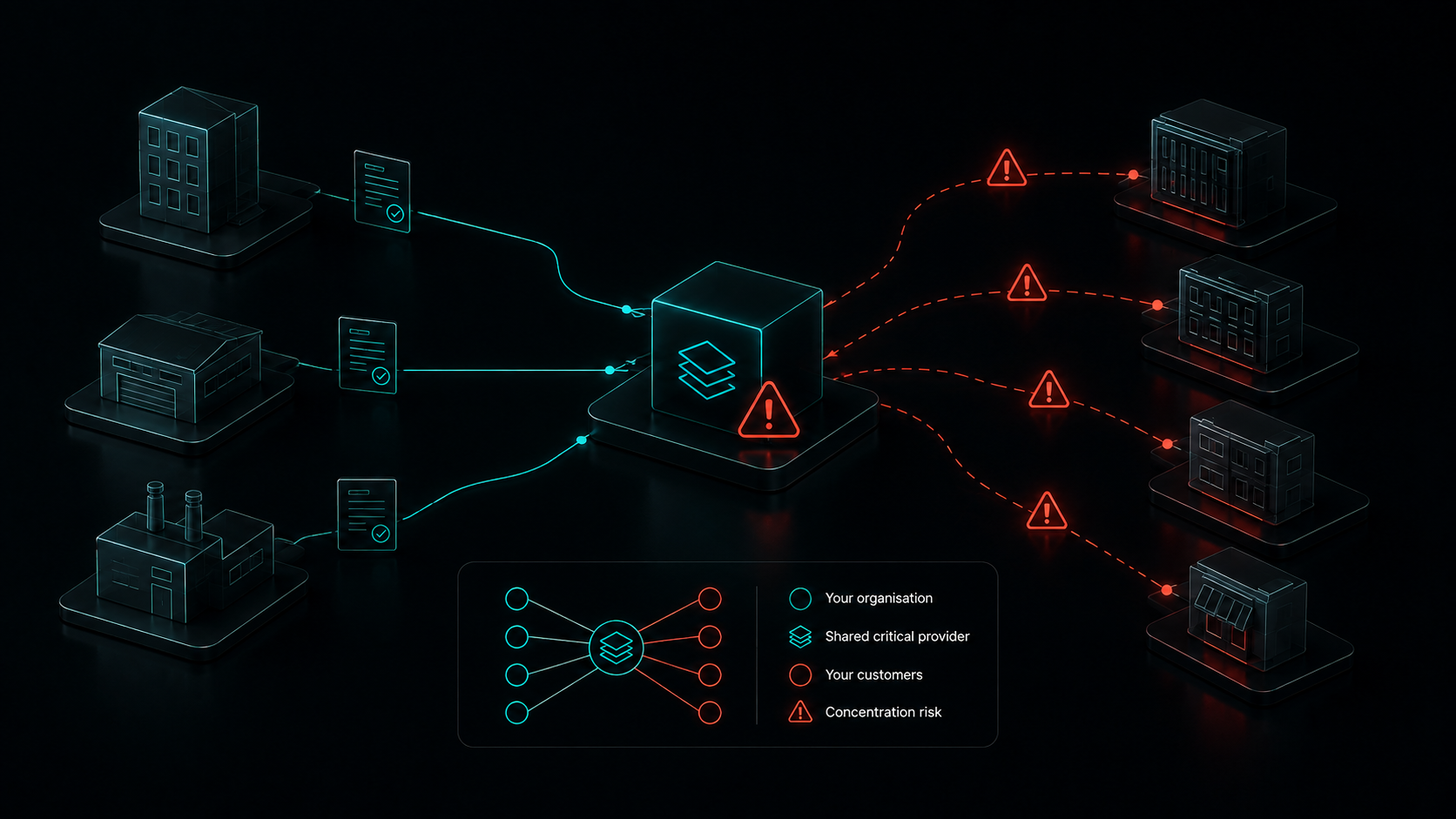
Hidden concentration is where one provider sits underneath several of your direct suppliers. If ten suppliers use the same data storage provider, an outage there could disrupt several of them together. How many are affected depends on which services they run on it and how they recover.
You won't find this form in your own records. It only appears when suppliers disclose what they depend on, so your view of hidden concentration is only as complete as those disclosures.
Both forms can be geographic, technological, operational or structural. In each case, one provider, region, platform or ownership group can affect several critical services or suppliers.
Third-party risk asks whether one supplier could harm you. Concentration risk asks how much of your organisation the same dependency could affect. The first is assessed one supplier at a time, mainly through security controls. The second depends on connections: which services and suppliers rest on the same provider, and what would fail together if it went down.
That difference changes what you look at. A questionnaire, certification review or audit produces useful evidence about how well one organisation protects itself, and that work still matters. It can't tell you that the supplier you rated low risk also supports your payments, your customer login and two of your other critical suppliers. You only see that by looking across relationships rather than within one. A well-controlled supplier can therefore still be a serious concentration risk. Good controls lower the chance that it fails, but they don't change how much fails with it.
Some concentration can't be avoided. Most organisations depend on a few large cloud, productivity and AI providers, either directly or through their suppliers. An incident at Microsoft or OpenAI will reach them whether or not they hold a contract. Sometimes accepting concentration is also the right call, such as when only one supplier can deliver a specialist service.
How serious a concentration is depends on how critical the affected services are and how much disruption you are prepared to tolerate. It matters most where critical services are involved. If your identity and access management provider goes down and customers can't log in to your app, the impact is immediate. Concentration among back-office suppliers with plenty of alternatives, such as accounting software, carries far less weight.
We can see where you have one company who might be deemed as low risk, but actually they're super critical to a bunch of banks, which on an aggregate layer means they're a much higher risk than people may perceive.

Supplier concentration risk takes five main forms:
Shared ownership cuts across all five, when suppliers that look separate turn out to sit under the same parent. Most organisations have several of these at once, and the less visible types tend to carry more risk.
Depending on the way they've integrated OpenAI or Anthropic into the platform, an incident at one of those providers might cause that tool to no longer work. So suddenly, one attack at one company might take offline a number of tools being used by an enterprise or public sector body.
One contracted supplier supports several of your critical systems, services or business units. If it fails, everything it supports is disrupted together.
CRM is a common example. If a platform such as Salesforce or HubSpot has an incident, marketing, sales and customer success can all be affected. This is the easiest type to find, because the evidence sits in your own contracts and service records.
Several of your direct suppliers rely on the same subcontractor, software provider, hosting platform or managed service. An outage there can disrupt several suppliers at the same time.
For example, your customer support software, identity provider and payroll platform might all use the same data storage provider. Supplier assessments rarely ask about this in a structured way, so it tends to come to light during an incident.
Several services depend on the same cloud environment, security product, software component or data service.
Cloud is the obvious case. A 2026 global survey of financial services firms by the Cambridge Centre for Alternative Finance found that the top three cloud providers serve more than 80% of the industry. Large infrastructure failures have shown what this looks like in practice. A Cloudflare outage in June 2022 took down sites that relied on its network. A faulty CrowdStrike update in July 2024 crashed Windows machines across many sectors.
Using the same cloud provider doesn't mean using the same region or service. That distinction decides whether two dependencies would actually fail together.
Critical operations, staff or infrastructure sit in the same region or legal jurisdiction. A grid failure, natural disaster, conflict or regulatory change there can affect every supplier in that location.
The Iberian blackout of April 2025 cut power across Spain and Portugal for much of a day. During it, internet traffic fell by 90% in Portugal and 80% in Spain, according to Cloudflare Radar. An earthquake in Taiwan or a new EU regulatory decision could cause similar knock-on effects further down the supply chain.
Separate supplier relationships depend on one operational capability, such as payments, communications, identity or data processing. When that capability fails, several services fail together.
AI model providers are the newest example. A handful of model providers now sit behind the AI features of many SaaS tools, often without the buyer knowing.
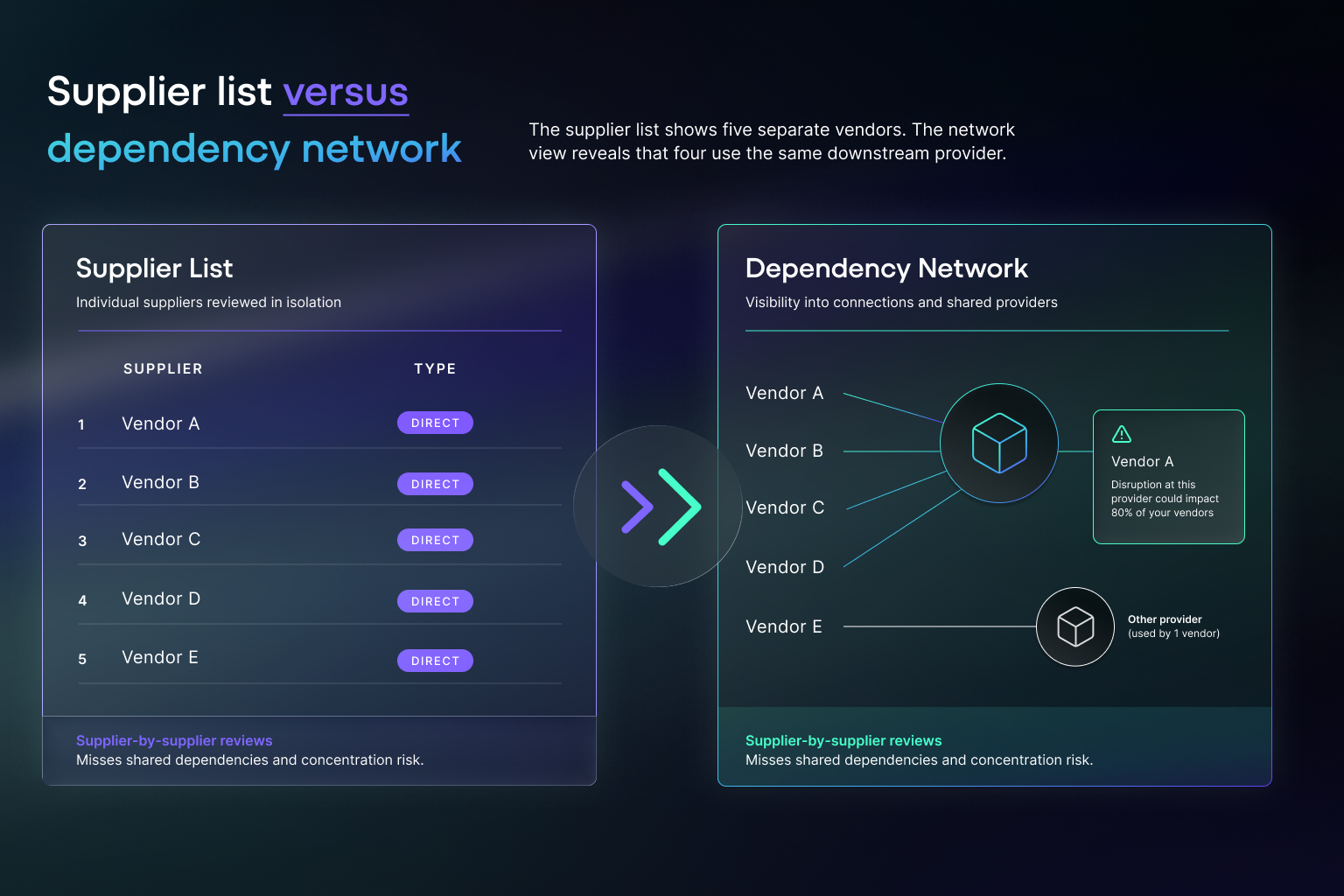
Traditional third-party risk management treats each supplier as an isolated node: assess it, score it, file it and move on. But modern supply chains are interconnected networks, not lists.
Third-party questionnaires and supplier lists generate useful evidence about individual suppliers. They give little insight into the shared fourth-party connections where many vendor concentration risks lie. Periodic self-reporting from suppliers also leads to inconsistent data that quickly goes out of date, which distorts your view of concentration.
With traditional supplier lists:
Hidden vendor concentration risk is concentration you can't see in your own records, because it sits in what your suppliers depend on rather than in your contracts with them.
Every organisation now has a large digital supply chain, but security teams struggle to see how deep its connections go. Supplier inventories miss shared fourth parties, and subsidiaries mask concentration at parent-company level. These hidden concentrations can cause far-reaching disruption, and they tend to go unnoticed until an incident exposes them.
Here are the five most common examples of hidden vendor concentration risk.
.png)
A shared provider is a reason to investigate, not proof that your suppliers will fail together. Two suppliers can use the same cloud provider through different services, regions and recovery arrangements. Two suppliers on different clouds can still share an identity provider or managed service provider. The real test is whether one incident could stop both of them delivering the service you need.
That makes dependency mapping the start of an investigation rather than the verdict. A map that flags every repeated name produces a long list of overlaps, most of which won't matter. The value comes from working out which overlaps sit on the path of a critical service, and which ones would survive a failure because something independent takes over.
The opposite mistake is just as common. Teams assume a backup is independent because it's a different company. In one case we've seen directly, a public sector team running a national testing programme had chosen two suppliers for a critical reagent. If one had an incident or went out of business, the other could take over. When we mapped the suppliers' own dependencies, both turned out to rely on the same fourth party. The backup arrangement hadn't removed the single point of failure, only moved it one tier down. Each supplier then switched to a different fourth party, which gave the programme two genuinely independent routes to supply. The case also shows that concentration risk isn't limited to software. Physical supply chains have the same failure.
When the same provider appears under several suppliers, work through these questions before deciding it's a concentration risk:
You won't be able to answer all of these yourself, and some suppliers won't know the answers straight away. Record what you can't confirm as unknown rather than treating it as safe.
Concentration risk matters for operational resilience because it decides how many services one failure can take down. Operational resilience asks whether you can keep delivering what matters through a severe disruption. Concentration decides whether that disruption hits one service at a time, or several together, which is much harder to recover from.
The connection is clearest when you start from services rather than suppliers. Take a service your customers or the public depend on, then trace what it needs to run. Concentration shows up wherever two of those paths meet at the same provider. A supplier list sorted by spend or risk score won't surface those meeting points, because it doesn't record which services each supplier supports.
UK firms in scope of the FCA and PRA operational resilience rules already work this way. They identify important business services and set an impact tolerance for each. They then map the people, processes, technology, facilities and information behind each service, including third parties.
The FCA is explicit that if a third party causes a breach of tolerance, the firm is responsible. So a fourth party shared across several important business services threatens several tolerances at once, and it belongs in scenario testing.
Most firms' maps stop at direct third parties. That's a reasonable place to start, but it's also where hidden concentration begins.
For public sector bodies, the equivalent is the essential service, whether that's benefits, healthcare, tax or local services. The Government Cyber Action Plan treats cyber risk as an operational risk, not just a technical one. It also moves oversight of high-risk suppliers away from individual departments towards coordinated oversight across government.
That shift matters because departments, local authorities and arm's-length bodies often use the same suppliers. Across the 26 government organisations in our network data, we found 224 third-party concentration risks rated critical. In each, an incident at one supplier would be likely to disrupt essential services at several public sector bodies.
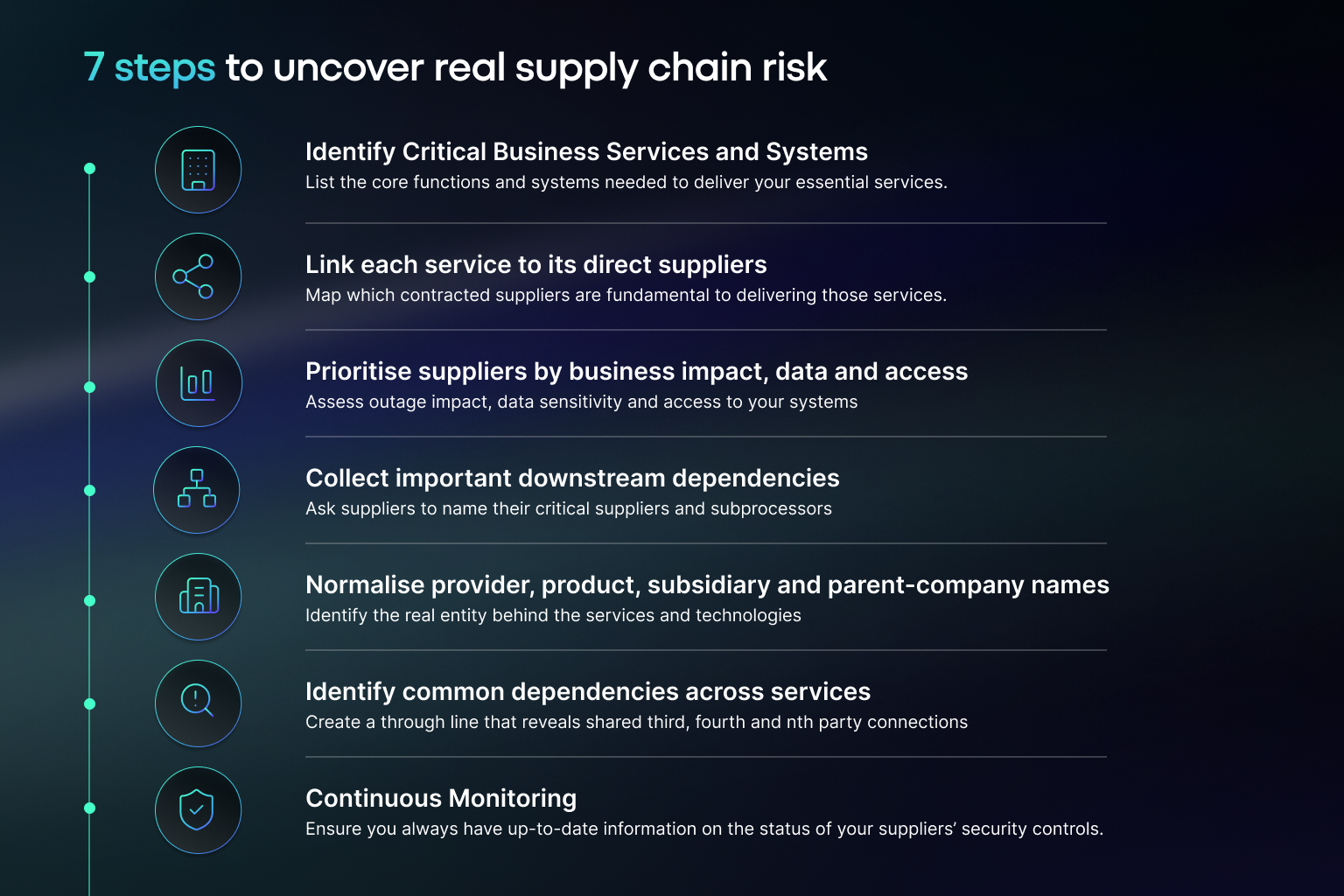
To identify vendor concentration risk, start from your critical business services and link each one to the suppliers that deliver it. Then collect those suppliers' own critical dependencies to find where the paths overlap. Prioritise by business impact, data and access, and focus on the services where disruption would exceed what you can tolerate.
Concentration risk is more common than most security teams assume. From AWS and Anthropic to Cloudflare and CrowdStrike, many direct suppliers rely on the same small set of cloud, identity and infrastructure providers.
Our own fourth-party discovery data shows the pattern. It covers critical fourth parties across live supplier connections on our network, and a handful of hyperscale and SaaS platforms sit underneath a large share of the wider supplier base. Google, AWS, Microsoft, Salesforce and HubSpot top the list.
This is vendor concentration risk in its clearest form, and it's hard to see from a supplier list alone. To decide where to act, you first need to identify and prioritise it in a structured way.
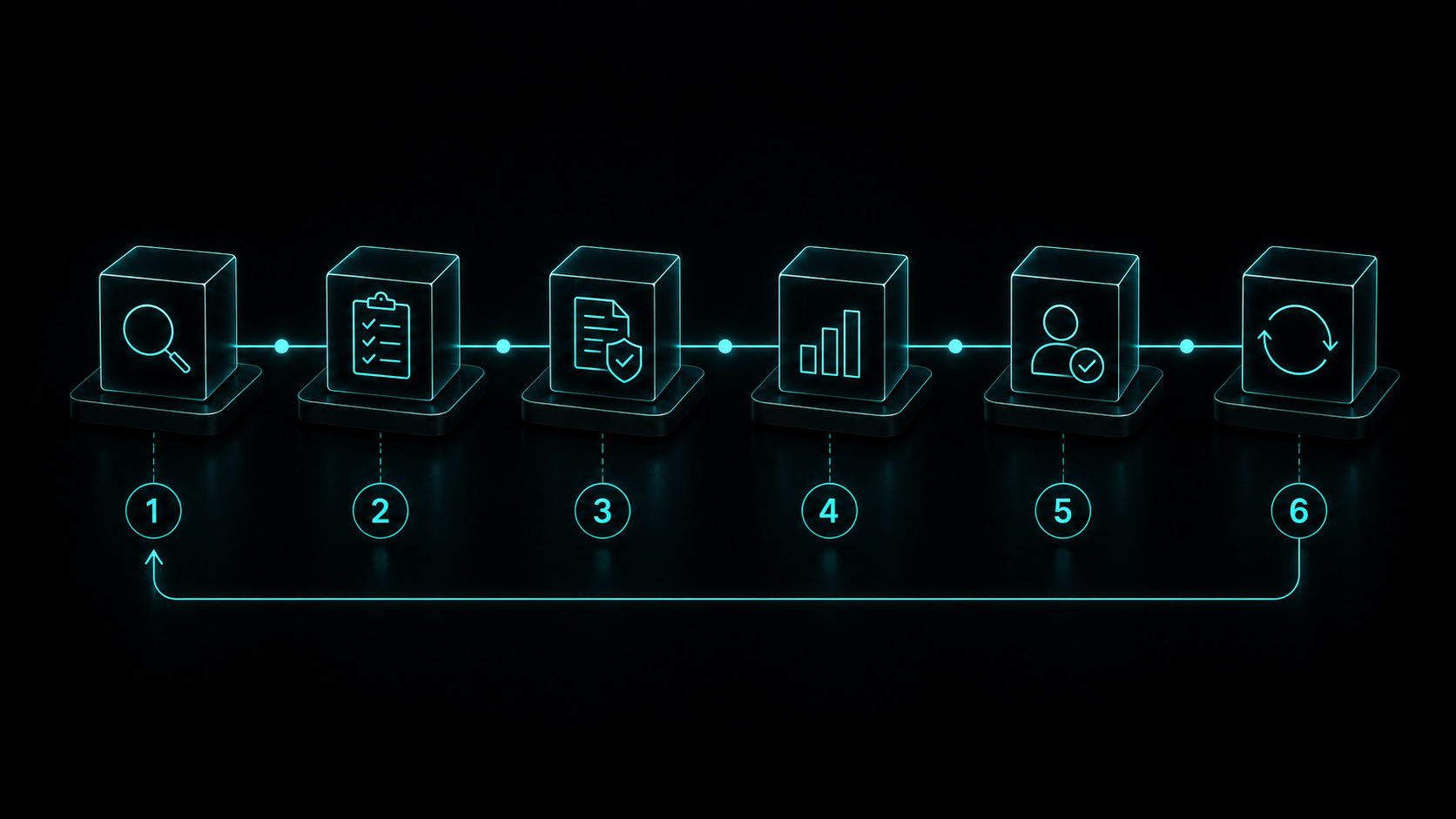
1) Identify critical business services and systems. List the core business functions that must keep running to deliver basic services to your customers or the public. For a financial services firm, the services might be retail banking and lending, and the systems would likely include CRM and identity and access management.
2) Link each service to its direct suppliers. Set out which contracted suppliers are fundamental to delivering each service. Some support it directly, such as a billing gateway. Others support it indirectly, such as ERP software.
3) Prioritise suppliers by business impact, data and access. Assess each supplier on three questions. How much would an outage affect your business? How much of your data does the supplier hold, and what would you do if you couldn't access it? What access does it have to your systems, if it were compromised?
4) Collect important downstream provider and technology dependencies. Ask your most critical suppliers to name their own critical suppliers and subprocessors, and which of your services each one supports. This is where shared dependencies start to emerge.
5) Normalise provider, product, subsidiary and parent-company names. Record the real entity behind each service. Several apps you use may turn out to be owned and operated by the same suite provider.
6) Identify common dependencies across critical services. Trace the third, fourth and nth-party connections behind each critical service, and mark where they meet.
7) Validate critical supplier relationships. Confirm that the connections you've found are current and relevant to the services you buy. Work through your contracted suppliers first. Contact fourth parties directly only where you have a clear reason and a route to do so. A supplier assurance platform can reduce the data-gathering burden.
Remember: you don't need to do this for every third-party supplier. Focus where disruption could:
Record each dependency in the same format, so overlaps can be compared and reported. A spreadsheet is fine to start with, as long as every entry captures the same fields.
You won't have a complete map, and you don't need one to start. Suppliers won't always disclose their dependencies, names won't always match, and some providers sit too far down the chain for you to influence. Regulators recognise this. The PRA, for example, doesn't expect firms to monitor fourth parties directly in every case. Its main expectation is that firms make sure their suppliers manage material sub-outsourcing well.
Work with the gaps rather than around them. Mark each relationship as confirmed, inferred or unknown, and note where the information came from and when it was last checked. Prioritise the unknowns that sit under important services, and ask the contracted supplier to clarify them first. Report unresolved gaps alongside what you've found, because an unmapped dependency isn't necessarily an absent one.
You measure vendor concentration risk by combining two kinds of information. The first is dependency data, meaning how many critical services and suppliers rely on the same provider. The second is business context: how hard that provider would be to replace, how long recovery would take, and what a failure would do to your services. No single metric is enough on its own.
Security teams should combine dependency data with business impact and recovery context. Consider measuring:
The most serious concentration risks combine high business criticality, broad dependency, limited alternatives and long recovery times.
Counting is where measurement starts, not where it ends. A provider that appears under forty suppliers is worth investigating, but the count alone says nothing about consequence. A provider that appears under three suppliers can matter more if all three support the same important service and none has an independent fallback. So use dependency counts to find concentrations, then use business impact, recovery and substitutability to decide which ones matter. Be wary of a single composite score. It can hide which factor is driving the risk, and that is usually the factor you need to act on. Regulators don't set a universal safe threshold either. What they ask is whether you can stay within tolerance when the dependency fails.
A vendor concentration risk is significant when a shared dependency supports critical services, spans several direct or indirect suppliers, has few genuinely independent alternatives and would take a long time to recover from. How many suppliers share a provider doesn't decide significance. Business impact does.
Just as you can't assure 1,000+ suppliers equally, there's no point trying to address every vendor concentration risk in the same way. To work out which concentration risks matter most, first identify which of your third parties are genuinely critical to an important business service. Then focus fourth-party analysis on those suppliers.
Here are the key factors to consider:
In financial services, "critical" usually means any concentration that could push an important business service outside its impact tolerance. In the public sector, it usually means a supplier whose failure would disrupt essential services at more than one organisation.
Use this analysis to work out what service disruption would look like in practice. Then decide how to reduce the impact if it happened, or remove the dependency altogether where that's possible.
To prioritise where to act, separate the core factors by level of concern, as in the grid below.
Mitigation should be proportionate to the business impact. Diversifying every supplier relationship would be costly and unrealistic. The aim is to understand where concentration could disrupt critical services, and to invest in resilience where the consequences justify it.
The most useful questions for critical suppliers cover three things: which downstream dependencies are essential to the service you buy, what happens if each one fails, and how recovery from those failures has been tested. Ask for answers and evidence specific to your service, not a general list of everyone the supplier works with.
Only ask these of your critical suppliers. Most suppliers already answer a steady stream of security questionnaires, so concentration questions get better answers when they're few, specific and asked once. Reuse the answers at reassessment rather than asking from scratch.
The most mature financial organisations will ask their suppliers, who are your critical suppliers? Who are you dependent on? They ask that in spreadsheets or whatever format, and they end up with lists of suppliers. What I don't think anybody does is then really cross-reference those lists.

A useful answer is specific. It names the service, the provider behind it, the region involved and the date recovery was last tested, along with the result. A weak answer describes the supplier's general resilience without connecting it to the service you buy.
A vague answer isn't always evasive. Many suppliers haven't mapped their own dependencies in this much detail, and finding that out is useful in itself. It tells you the supplier's view of its own concentration is as incomplete as yours. Record those gaps as unknown, agree a date for a fuller answer, and use contract renewal to make dependency disclosure and change notification a standing commitment rather than a favour.
Where an answer reveals that a backup shares a dependency with the primary, treat that as a finding, not a detail. It's the most common reason recovery plans fail when they're needed.
An alternative supplier is only viable if it can deliver the capability you need, take on the workload in time, and avoid the dependency that caused the failure. An alternative that exists in the market isn't necessarily one you can use within your disruption tolerance.
Substitutability is easy to overstate. Teams often mark a supplier as low concentration risk because "there are plenty of alternatives". That's true at the level of the market, but it doesn't hold for an organisation that needs to switch next Tuesday. Contracting, security review, data migration and integration all take time, so it's the time to switch that matters, not just whether competitors exist.
An alternative supplier can serve two different purposes, and they need separate plans.
Emergency continuity keeps a service running through a disruption, usually within hours or days. That means failover, a standby provider, a degraded mode or a manual workaround. Long-term exit moves the service to a new supplier in a planned way, usually over months. A replacement you could onboard in six months supports an exit strategy, but it does nothing for tomorrow's outage.
UK financial services regulators draw the same line. The PRA's SS2/21 distinguishes stressed exits, where an arrangement ends unexpectedly, from non-stressed exits, which are planned for commercial or strategic reasons. It focuses mainly on business continuity and stressed exits. It also expects firms to define what a successful exit would look like in measurable terms, such as cost, functionality and time, and to test the plans on a risk-based approach.
For some services, there's no realistic alternative within the timescale that matters, whether that's a hyperscale cloud platform or a niche specialist supplier. In those cases, a second supplier isn't the answer. The work shifts to degraded operation, faster recovery, and a documented decision to accept the remaining exposure.
Security teams reduce vendor concentration risk in three ways: removing dependencies they don't need, building genuinely independent recovery for the ones they do, and documenting the exposure they choose to accept. The aim is concentration that is known, justified and survivable, not zero concentration.
Once you've identified and prioritised your vendor concentration risks, start reducing exposure on the most critical ones. This playbook draws on our work with customers, including what hasn't worked as well as what has.
Remove unnecessary dependencies: Start with the easy wins. Remove non-essential components or services that add avoidable exposure, especially where you could switch providers easily or use internal resources instead.
Diversify providers where alternatives are viable: Spread services across suppliers in markets with several options of similar quality, such as accounting or invoicing software. Diversifying only helps if the alternative avoids the dependency you're worried about. It also adds cost, integrations and another supplier to assure, so save it for concentrations that matter.
Design redundancy, isolation, backups and failovers: Plan for critical supplier failure, with backup suppliers for outages and isolation protocols for breaches. For every pairing of critical supplier and backup, check explicitly that they don't share a critical fourth-party dependency.
The usual objection is that both failing at once is too unlikely to plan for. Shared software makes it much more likely. When the MOVEit Transfer vulnerability was mass-exploited in 2023, organisations across many sectors were hit through the same file-transfer tool at the same time, often through their suppliers. That single check removes one of the most common reasons a disaster recovery plan fails when it's needed.
Reduce data, access and service coupling: Build abstraction layers and keep data portable, so you're less locked in to any one vendor and can isolate critical systems during a disruption. This reduces switching friction. Test whether a transition is actually feasible within the time you'd need it.
Improve incident, exit and cooperation clauses: Write contract terms that make concentration manageable. These include disclosure of critical fourth parties, notification of material dependency changes within a set timescale, cooperation during incidents, exit assistance and data return. These clauses only help if someone owns the process of acting on them.
Monitor ownership, service and dependency changes: Track new subprocessors, hosting providers, infrastructure changes, acquisitions and changes in parent-company ownership. Combine this with supplier disclosures, financial-health information, regulatory developments, adverse media and cyber incident signals. A concentration you've accepted can quickly become significant when the supplier relationship or the threat environment changes.
Run tabletop exercises and failure simulations: Test what happens if a critical supplier, cloud region or shared fourth party becomes unavailable for 24 to 48 hours. Use the exercise to expose hidden interdependencies, validate recovery plans, and check whether supposedly independent backup suppliers rely on the same underlying provider.
Prepare a response for when a supplier is down: If you can't remove the dependency, prepare a recovery strategy. One approach is to borrow the hot and cold site concept from business continuity and apply it to suppliers. Identify a third option that you could stand up quickly if your primary and backup suppliers both fail. A contact there is a start. You also need to know it has the capacity, can onboard you in time and can work with your data, and ideally you've tested the route before you need it.
Note: the goal is not zero concentration. It is known, justified and survivable concentration.
Not every finding calls for action. Some call for evidence, and some for a documented decision to accept the risk. Match the response to what you actually know.
If you're starting with limited time, pilot the approach on a single service rather than the whole supplier base.
The output should be a decision record you can use, not a bigger supplier inventory. You also don't have to do it alone. Security teams in your sector probably use many of the same suppliers. Asking a peer whether they've already looked at a supplier can save you repeating work, and frees your time for the suppliers nobody has checked.
UK regulators don't set a limit on supplier concentration. They expect organisations to know which third parties support their critical services, to assess what happens if those fail, and to show they can recover.
Financial services firms meet this through outsourcing, operational resilience and third-party reporting rules. Central government meets it through the Cyber Assessment Framework, assessed under GovAssure.
This is a summary, not legal advice. Check the primary texts for the obligations that apply to you.
Outsourcing and third-party risk management: The PRA's SS2/21 is the main reference for PRA-regulated firms. It expects firms to assess concentration within material outsourcing arrangements, including sub-outsourcing, geographic clustering and vendor lock-in. It also expects them to plan for stressed exits.
Operational resilience: Under the FCA and PRA operational resilience rules, firms must map the third parties behind their important business services. They must be able to stay within impact tolerance through severe but plausible disruption. A fourth party shared across several important business services should be part of that scenario testing.
Third-party reporting:; This is the newest requirement. PS26/2, with the PRA's equivalent PS7/26, applies from 18 March 2027. It defines a material third party arrangement and requires firms to notify regulators of new or significantly changed arrangements. Firms must also maintain a register of material arrangements and submit it to the FCA every year.
The definition reaches further than many firms expect. It covers outsourcing and non-outsourcing arrangements, intra-group arrangements and sub-contracting chains. Materiality is assessed against risks that include third-party concentration risk. So a register that lists suppliers without their dependencies will make materiality hard to judge, and hard to defend.
Critical third parties: The CTP regime has applied since 1 January 2025 to third parties that HM Treasury designates. It's about the regulators overseeing those providers directly. It doesn't apply to the firms reading this, and it doesn't transfer any risk. Firms remain responsible for managing their own third-party risks under the existing operational resilience and outsourcing rules.
UK firms with EU entities may also fall under DORA, which has its own ICT concentration risk requirements. [Link: our DORA guide]
GovAssure and the Cyber Assessment Framework: GovAssure assesses government critical systems against the NCSC's Cyber Assessment Framework (CAF). CAF principle A4 asks organisations to understand and manage security risks that arise from their dependencies on suppliers.
The indicators of good practice are explicit about sub-contractors, meaning your suppliers' suppliers. An organisation with little or no visibility of the sub-contractors in its supply chain doesn't meet the outcome. The fully achieved level calls for a deep understanding of the supply chain, including sub-contractors.
The Government Cyber Action Plan: The plan moves oversight of high-risk suppliers from individual departments to a coordinated, cross-government view. That makes shared suppliers across departments and arm's-length bodies a central concern rather than a local one.
The Cyber Security and Resilience Bill: The Bill amends the NIS Regulations 2018 and brings managed service providers into scope. When this guide was updated, it was still in the House of Lords and hadn't received Royal Assent. Royal Assent is expected in late 2026, with most obligations phased in through secondary legislation, possibly as late as 2028. Treat it as the direction of travel, not a current requirement.
Vendor concentration risk needs a network view because concentration comes from connections, not from individual suppliers. Assessing suppliers one at a time tells you about each organisation. Mapping how they connect shows where several depend on the same provider, and how far an incident could spread.
In a hyper-connected economy, an obscure company deep in your supply chain can undermine your operational resilience. Traditional TPRM treats suppliers as separate entities and concentrates on direct relationships. That leaves the web of fourth, fifth and nth parties behind your critical services largely out of view.
Security teams recognise the gap. In Every Link Matters 2026, 96% of CISOs said extended supply chain visibility was essential for mitigating risk. The same report shows how far most organisations are from it: 30% of UK security and TPRM professionals said they had full visibility of the subcontractors behind their important business functions.
Where organisations do look beyond their direct suppliers, it's usually a one-off exercise. Even mature financial services firms that ask critical suppliers for their own supplier lists tend to analyse those lists once. Few cross-reference them to find overlaps, and nothing alerts them when the picture changes.
Individual supplier assurance, such as third-party questionnaires and direct supplier registers, tells you who you buy from. It establishes what's true about one organisation at a point in time, and that evidence still matters. A network view, such as live supply chain mapping, shows how those organisations connect, which suppliers they rely on and where risk can spread.
With a static, spreadsheet-based list of vendors, concentration risks are hard to spot and harder to track as they change. A network view works differently. When many organisations and their suppliers share dependency information on one network, overlaps that no single organisation could see on its own start to appear. Each supplier maintains its information once, rather than answering the same question for every client.
The view has limits. Its coverage depends on which suppliers take part and what they disclose. It shows you where to look, but you still judge which overlaps matter for your services.
To build a network view, make sure your operating model combines:
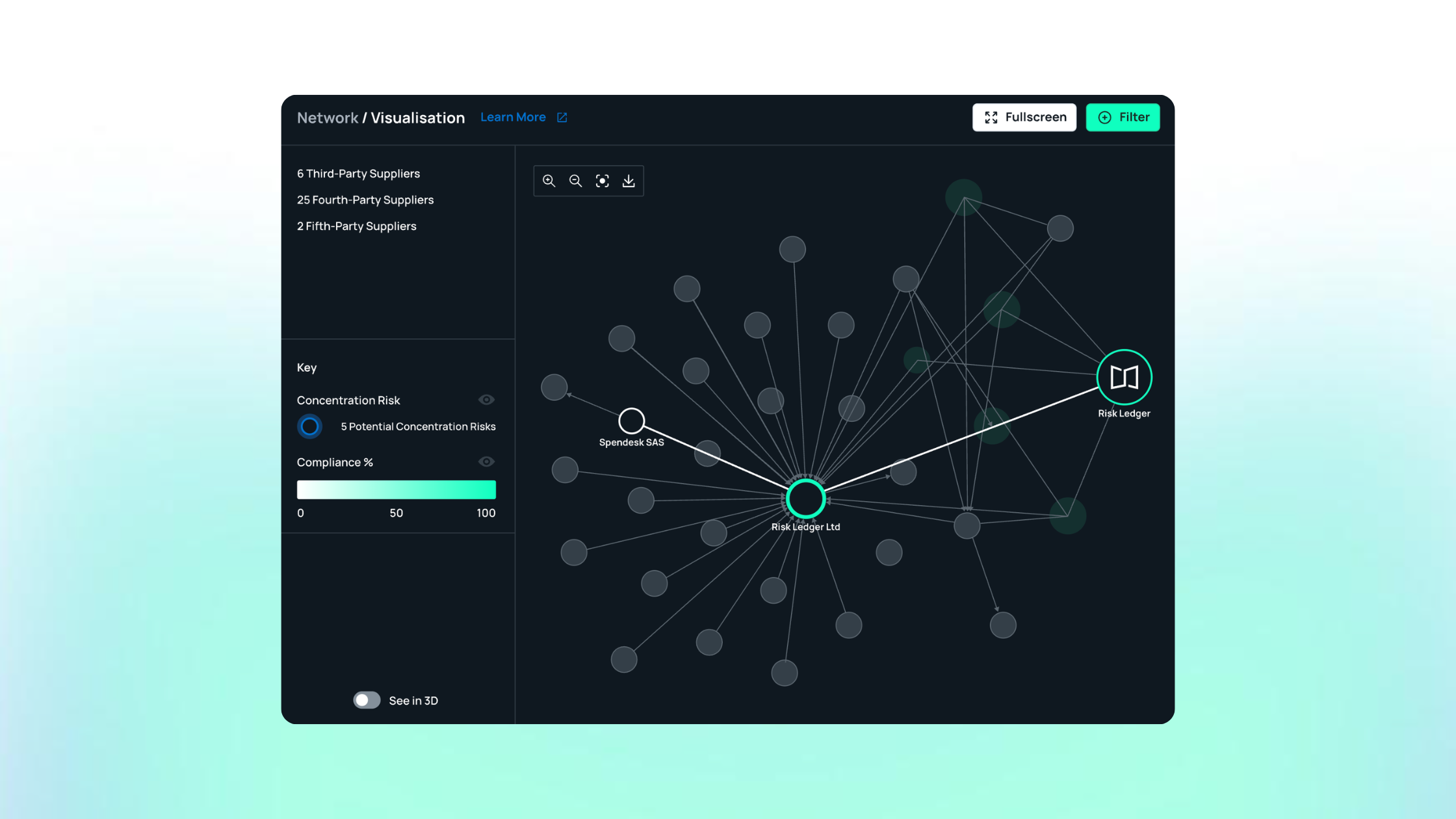
Risk Ledger helps security teams find shared dependencies across their suppliers, investigate them with the suppliers involved, and record and manage the concentration risks that matter.
It works because suppliers keep a single profile on a shared network, including their own critical suppliers. That means overlaps show up across organisations, instead of each client rebuilding the picture on its own.
When we analysed supplier relationships for UK financial institutions and government organisations on our network, concentration showed up well beyond direct suppliers.
1) Find shared dependencies. Suppliers declare their critical suppliers on their profile. Our network visualisation then shows how your suppliers connect, from third parties out to sixth parties where the network holds that data. Providers that sit under several of your suppliers stand out on the map.
2) Investigate the relationship. See which of your suppliers connect to the shared provider, and check that provider's own profile if it's on the network. Then ask the suppliers involved directly, inside the platform, which of your services the dependency supports.
3) Assess the impact. Set the shared dependency against the critical services and suppliers you've identified. This step stays your judgement. We show you the connection, and you decide what it means for your services and your tolerance.
4) Record and manage the risk. Open a concentration risk against the organisation, including one beyond your direct suppliers, and assign an owner. Then track the mitigation or acceptance decision through to closure.
Our visibility depends on what suppliers declare and which organisations take part in the network. Where a relationship hasn't been declared, we can't show it. So treat the map as a strong starting point for investigation, not a complete inventory.
PRA SS2/21: Outsourcing and third party risk management
PRA SS2/21, Chapter 10: Business continuity and exit plans
FCA PS21/3: Building operational resilience
PRA SS1/21: Operational resilience: impact tolerances for important business services
FCA: Operational resilience insights and observations
FCA PS26/2: Operational incident and third party reporting
FCA: Critical third parties
NCSC Cyber Assessment Framework: Principle A4, Supply chain
UK Government Cyber Action Plan
UK Parliament: Cyber Security and Resilience (Network and Information Systems) Bill
CISA Advisory AA23-158A: MOVEit Transfer vulnerability
Cambridge Centre for Alternative Finance: 2026 Global AI in Financial Services Report
Cloudflare: Outage on 21 June 2022
Harvard Business Review: What the 2024 CrowdStrike glitch can teach us about cyber risk
JPMorganChase: An open letter to third-party suppliers
SecurityWeek: Major US banks impacted by SitusAMC hack



Monthly research, case studies and practical guides you won't find anywhere else.
Join thousands of security managers turning their TPRM programmes into success stories.

.svg)