October 9, 2026
・
23
mins read
.png)
Good supply chain threat response is the ability to answer one question fast when a threat lands: are we affected, and by how much. It depends entirely on groundwork done long before any specific threat exists, not on anything assembled once one does.
The middle of a live threat is the worst possible time to work out which suppliers matter, who owns each relationship, or how to reach them. By then, the only options left are slow ones: a scramble through spreadsheets, or an email to every supplier on the list. Neither answers the question quickly, and neither was ever going to.
Without that, a response can't be targeted, because targeting requires already knowing where to point it.
This is the same understanding a supply chain programme should already be building day to day: what's critical to the business, what's sensitive, and which suppliers those things are outsourced to. A threat doesn't need a different version of that picture. It needs the current one, ready to use on a shorter timescale than usual.
If that context lives in someone's head or an out-of-date spreadsheet, it isn't ready. It has to be current and accessible before anyone needs it, not reconstructed while a threat is already active.
Without a platform doing this automatically, narrowing has to happen before contact. Criticality and sensitivity decide which suppliers get asked at all.
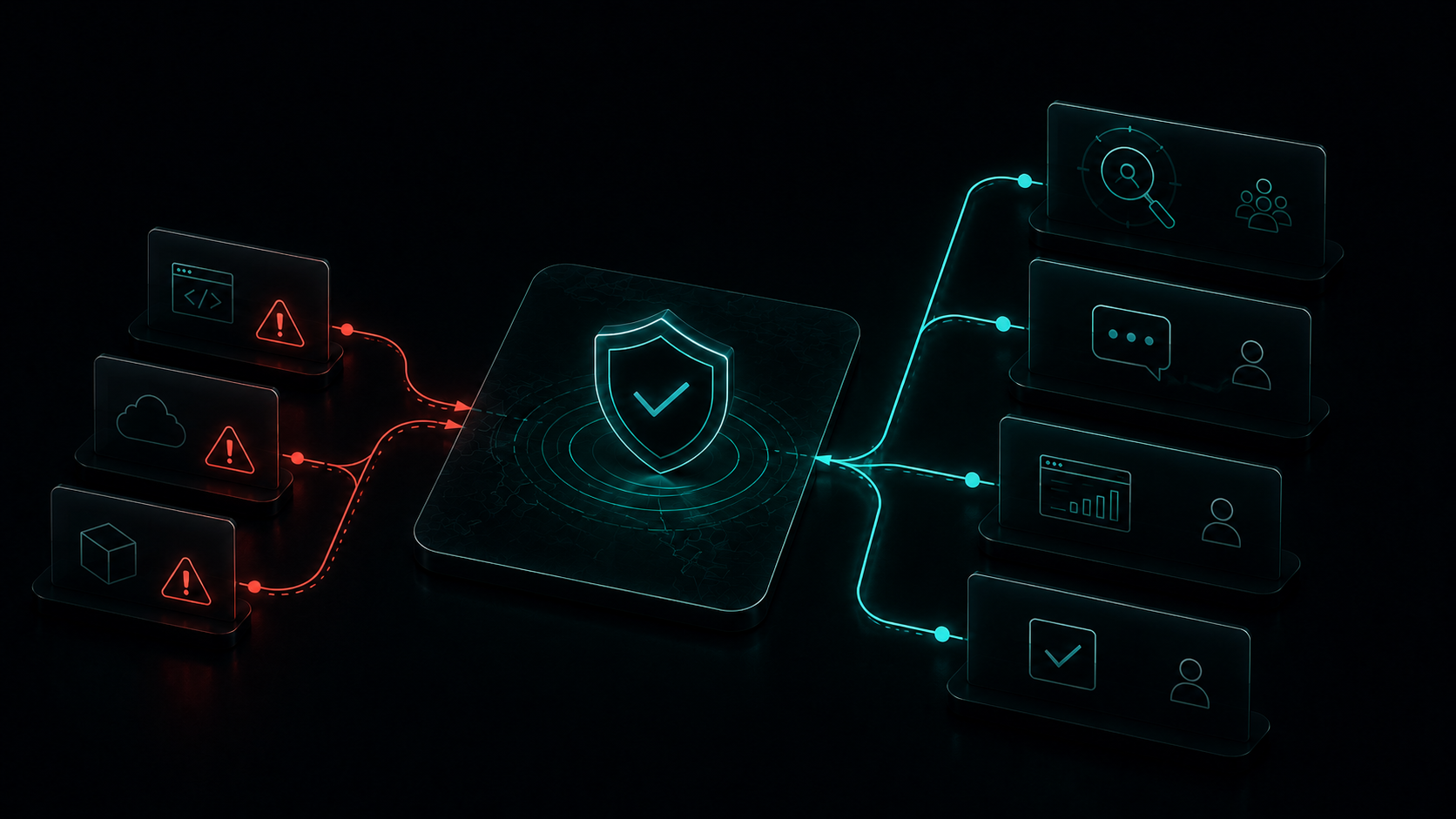
Risk Ledger works the other way round. Every connected supplier is asked the same three questions automatically when a threat is published, so there's nothing to narrow before contact. Criticality and sensitivity decide which responses get acted on first instead.
The information behind the narrowing doesn't change either way: which suppliers are likely to use the affected technology, which support critical services, which hold sensitive data, which have privileged access. What changes is whether that information filters who gets asked, or filters which answer gets read first.
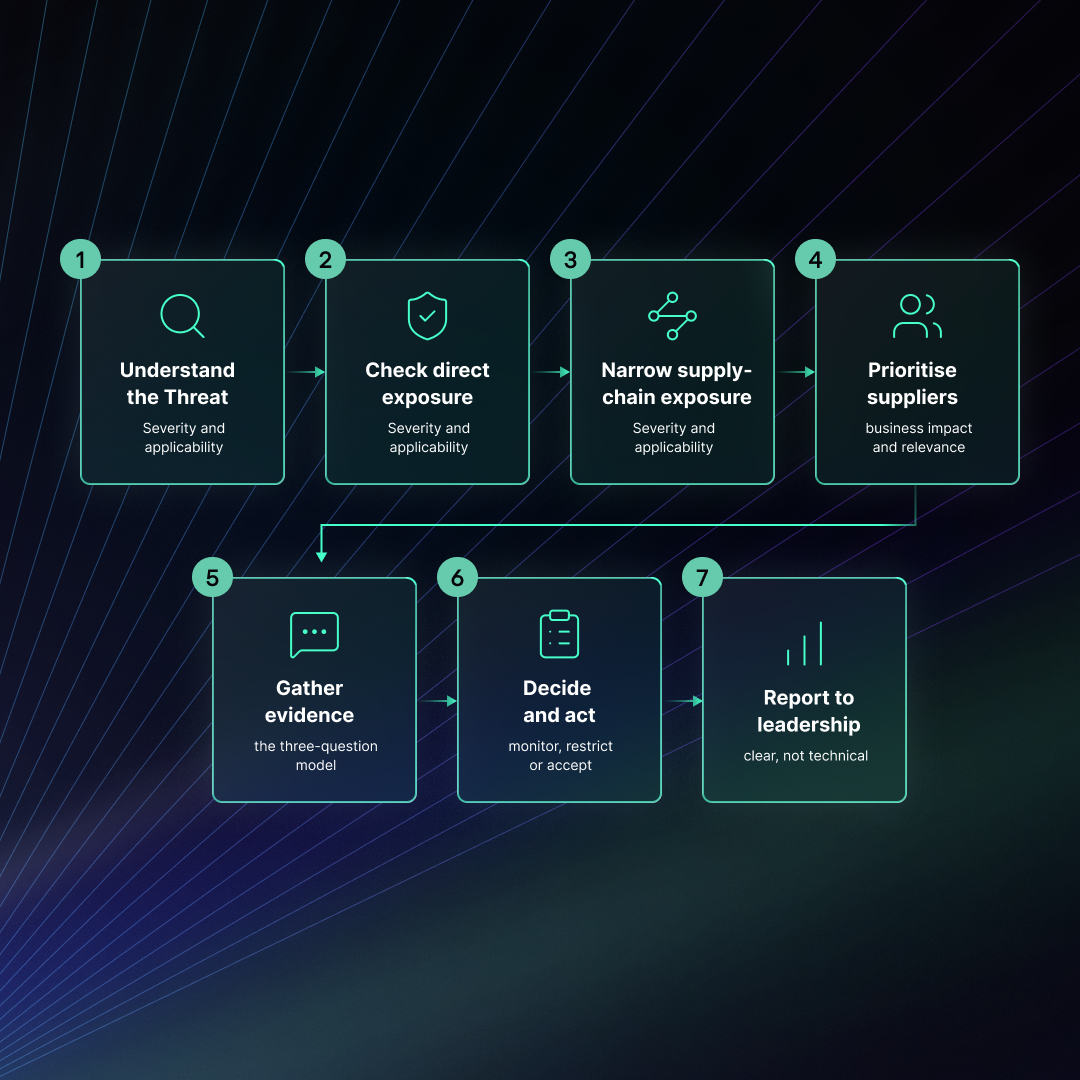
Before contacting a single supplier, work out what's actually happened. Most emerging threats fall into one of a few categories: a critical software vulnerability, a confirmed incident at a specific supplier, or a wider operational event with no security cause at all.
The most common trigger is a vulnerability, usually a CVE scored by NIST or MITRE. A score above roughly 9.8 tends to warrant attention, but the score on its own doesn't tell you what to do. It only tells you how bad the vulnerability could be in theory, not whether it touches you or your suppliers in practice. That's a separate question, covered in full in Are We Exposed To Emerging Supply Chain Threats?.
It's also worth being clear about the difference between a threat and an incident. A threat is the potential of an incident occurring, nothing more. It only becomes an incident once there's confirmed impact, and confirmed impact is specific to the organisation involved.
A supplier having an incident doesn't automatically mean the organisation using them has one too. Response should sit in that space before confirmation, working to establish exposure and prevent escalation, not to manage an incident that hasn't actually happened yet.
Getting this distinction wrong is common, and costly. Some teams trigger full incident response procedures the moment a supplier reports trouble, even with no confirmed impact to them at all. That creates work and noise without anything to show for it, and pulls attention away from the suppliers where something might genuinely need checking.
Before looking anywhere near the supply chain, check the environment already under direct control. This step should be quick, and it's internal by design.
The questions are straightforward. Does the organisation use the affected technology directly? Is there any evidence it's already been compromised? And if a fix exists, can it be applied now?
Direct exposure is the easier half of this problem, because the information needed to answer it already sits inside the organisation. There's no supplier to wait on and no third party to interpret. An up-to-date asset register should make this a same-day exercise, in principle within a few hours.
In practice, it's often slower than it should be, usually because asset records aren't kept current rather than because the check itself is hard. Patching adds its own friction too. Taking systems offline to apply a fix has real operational consequences, which is why patches sometimes take weeks to roll out rather than hours, even once one is available.
This internal check matters for a second reason beyond fixing the immediate problem: it sets a baseline. Once direct exposure is understood, whatever's left is the genuinely external question, and that's where the response starts to depend on suppliers rather than internal records.
Keep this step brief. The real complexity in supply chain threat response isn't here, it's in what comes next.
Once direct exposure is understood, the question changes. It's no longer "are we affected" but "could our suppliers be affected, and does that reach us."
Answering that depends on the same criticality and sensitivity picture either way. Some organisations use it to decide who to ask. Others, including Risk Ledger customers, ask everyone connected as standard practice and use it to decide which answers to act on first.
If outreach has to be done by hand, narrowing comes first: you use criticality, sensitivity and access to cut the supplier list down before anyone gets an email.
Risk Ledger customers narrow the other way round. Every connected supplier is asked the same three questions as standard practice, and the criticality work is what turns the responses into a shortlist once they land.
The judgment call is identical either way. It's the order that flips, not the logic behind it.
This is where it's easy to overreach. Potential exposure and confirmed impact are not the same thing, and treating them as equivalent is how organisations end up either panicking early or contacting far more suppliers than the threat actually warrants. The goal at this stage is to narrow the field, not to escalate everything in it.
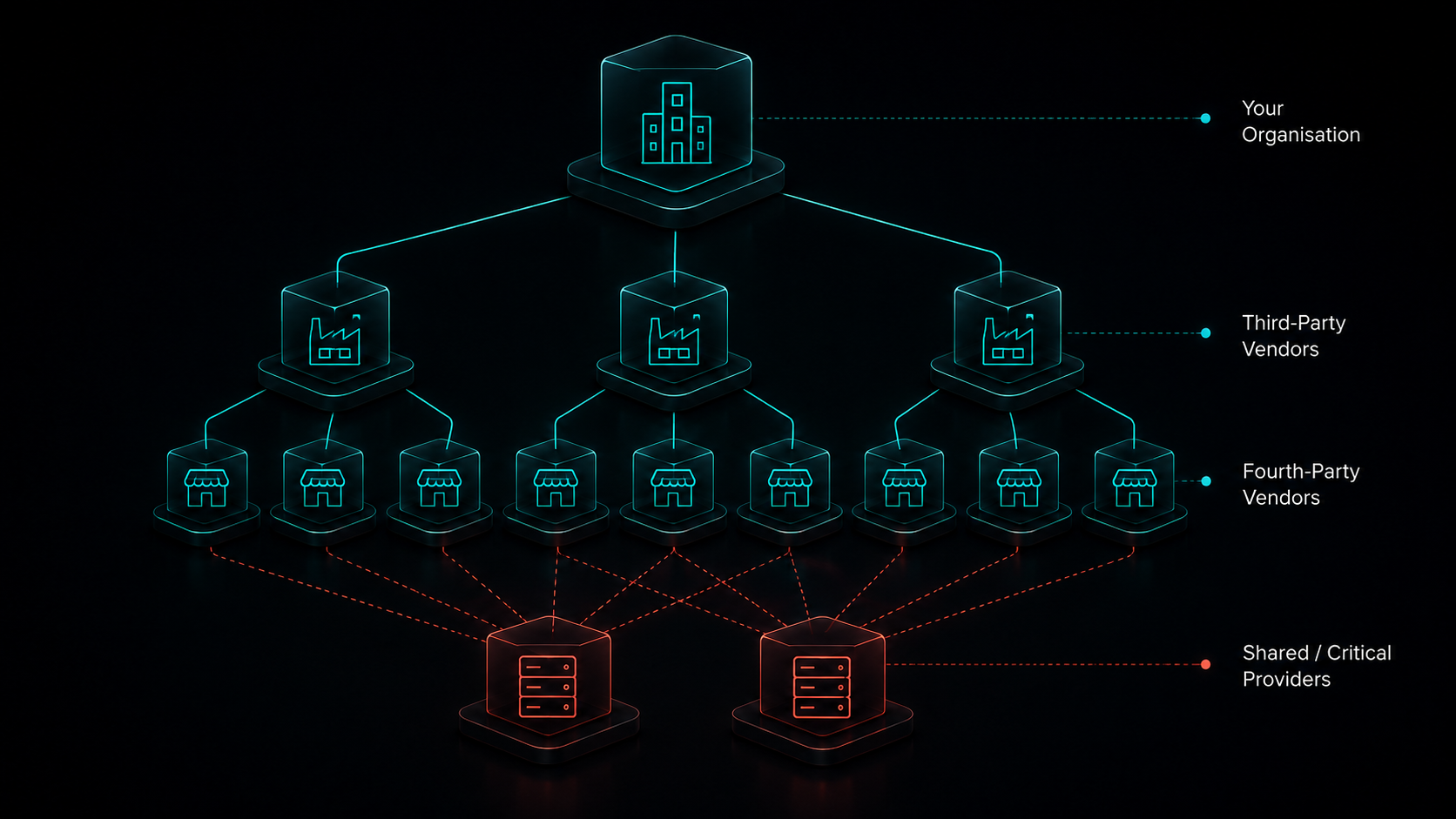
Narrowing means working out which suppliers are likely to use the affected technology, which support critical services, which hold sensitive data, which have privileged access, and whether any known downstream dependencies could be in scope even if a direct supplier isn't. That's the filter for what you escalate on and what you act on, not necessarily for who gets asked the three questions in the first place.
That last point matters more than it seems. A supplier can answer "no" for themselves while still depending on something further down the chain that says yes - which is exactly the fourth-party problem we covered in What Hidden Supplier Dependencies Could Increase Our Risk?.
Not every disruption at a supplier is worth this process, either. Some incidents are straightforward regardless of cause. When a major cloud provider goes down because of an infrastructure fault rather than an attack, there's usually nothing to investigate, only a wait for service to resume, unless a failover already exists elsewhere.
Once the field is narrowed to the suppliers that plausibly matter, the next step is deciding what to do with what comes back and in what order, which we went in-depth on in Which Suppliers Should We Contact First During A Supply Chain Incident?.
Getting a response back from a supplier isn't the end of the work, it's the start of the part that actually matters.
Once the three answers are in - is the technology in use, has it been fixed, is there evidence of compromise - the response and the supplier's importance to the business together determine the next step.
A supplier confirming they use the affected technology but have already patched it needs logging, not urgent action. A supplier confirming they use it, haven't patched it, and have no date for when they will is a different situation, and depending on what that supplier holds or accesses, the options include restricting access, adding monitoring, briefing the internal team who owns the relationship, or reviewing continuity plans in case the supplier becomes unavailable.
Confirmed compromise moves things further still, closer to an active incident than a managed risk, and the case for acting immediately gets much stronger.
None of these actions are automatic, and none apply to every supplier that responds. They apply where the response, combined with what that supplier means to the business, actually warrants it.
There are real trade-offs here to be aware of. Cutting off a supplier reduces exposure, but it isn't free. Imagine a security team telling a production line to shut down for six hours over a possible risk. That's a guaranteed cost, accepted to prevent a risk that might not have materialised at all. Making that call well depends entirely on having the context to weigh one against the other. Without it, the safer-feeling choice is usually to do nothing and hope the risk stays small, which is its own kind of gamble.
If you have the right information, you can make those decisions well, to protect against much wider incidents. If you don't have the information, you're never going to be brave enough to accept a known cost to prevent a potential one.
 Emily Hodges
COO, Risk Ledger
Emily Hodges
COO, Risk Ledger
Once suppliers have responded and decisions have been made, leadership still needs an answer, and it needs to be a short one. The job at this stage is to reduce uncertainty, not to hand over a technical report.
A useful update covers five things:
This works because of everything that happened earlier in the process. A team that skipped straight to a blanket email and is still waiting on unstructured replies has nothing concrete to report beyond "we're looking into it." A team that narrowed the question, prioritised the right suppliers, and got specific answers can say exactly what's affected, what isn't, and what's happening next. The update is only as clear as the work behind it.
This is also where the earlier discipline pays for itself in a different way. Escalating because "a supplier has an incident" invites more questions than it answers. Escalating with the business consequence already worked out is a different conversation entirely, and a much shorter one.
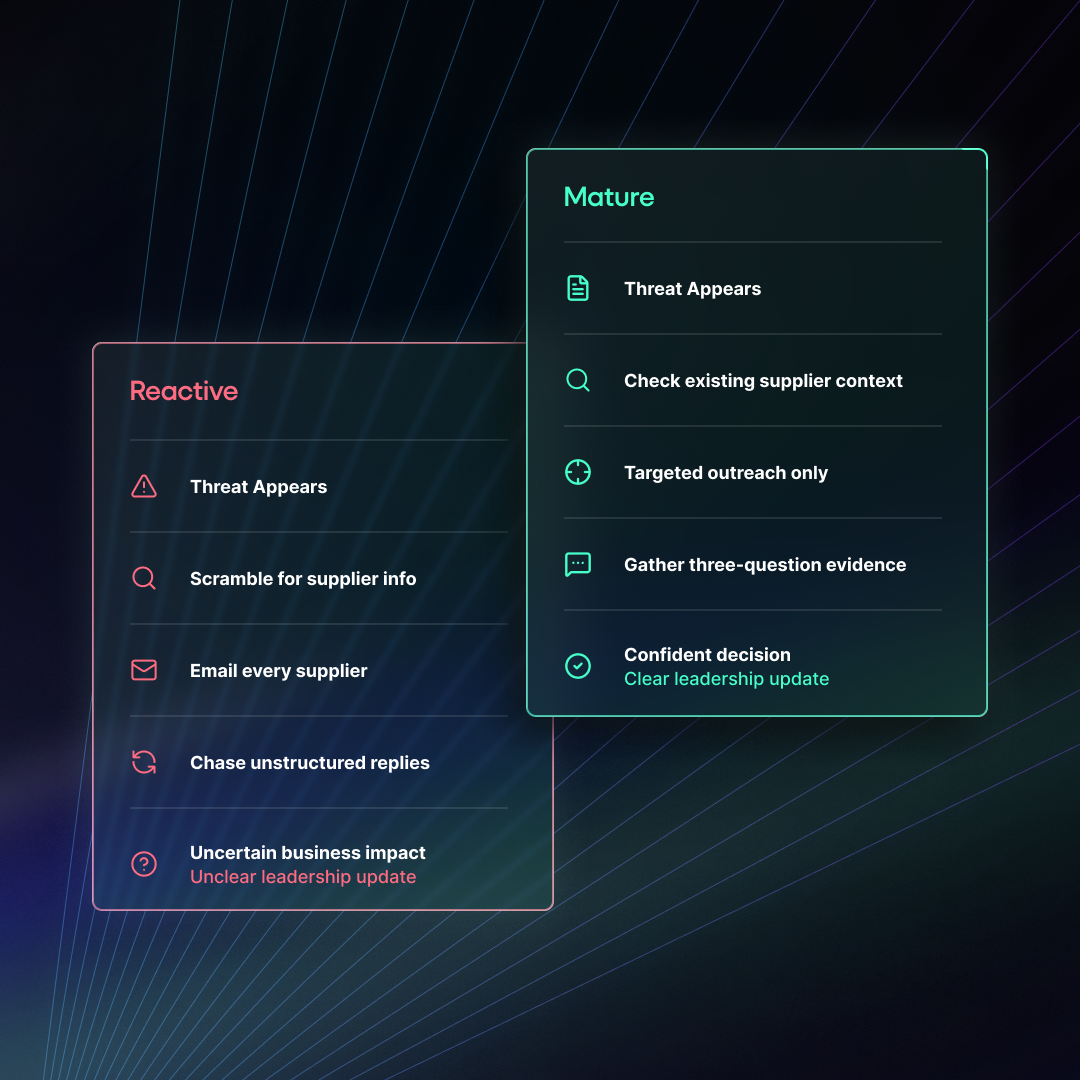
Reactive response starts the same way mature response does, a threat appears, but from there it splits. One path scrambles for supplier information that was never organised in advance, emails everyone regardless of relevance, chases unstructured replies, and ends with an uncertain picture that's hard to report on with any confidence. The other path checks context that already exists, gets the same three pieces of evidence from a structured process every time, and knows which responses to prioritise the moment they land.
The difference isn't more tooling, and it isn't more effort in the moment. It's what was already in place before the threat showed up.
The indicator of a mature response is how targeted it can be, and whether it's likely to lead to any real action. Less mature organisations gather data because they feel they should, without a clear sense of what to do with it.
Emily Hodges
COO, Risk Ledger
Mature teams aren't the ones with the most complete map of every supplier they've ever worked with. They're the ones who did the groundwork before they needed it, so that when a threat does land, the only real decision left is who to contact and what to do with the answer.
These events don't happen often. When they do, they tend to land at the worst possible time, and the teams who've prepared are the ones who don't lose the next few hours to a scramble.
At Risk Ledger, we don't treat emerging-threat response as a separate exercise. The supplier data, criticality, and contact routes needed to run this whole process are already current as part of how a Risk Ledger customer's supply chain programme runs day to day. Nothing extra has to be built when a threat appears, because it was built in already.
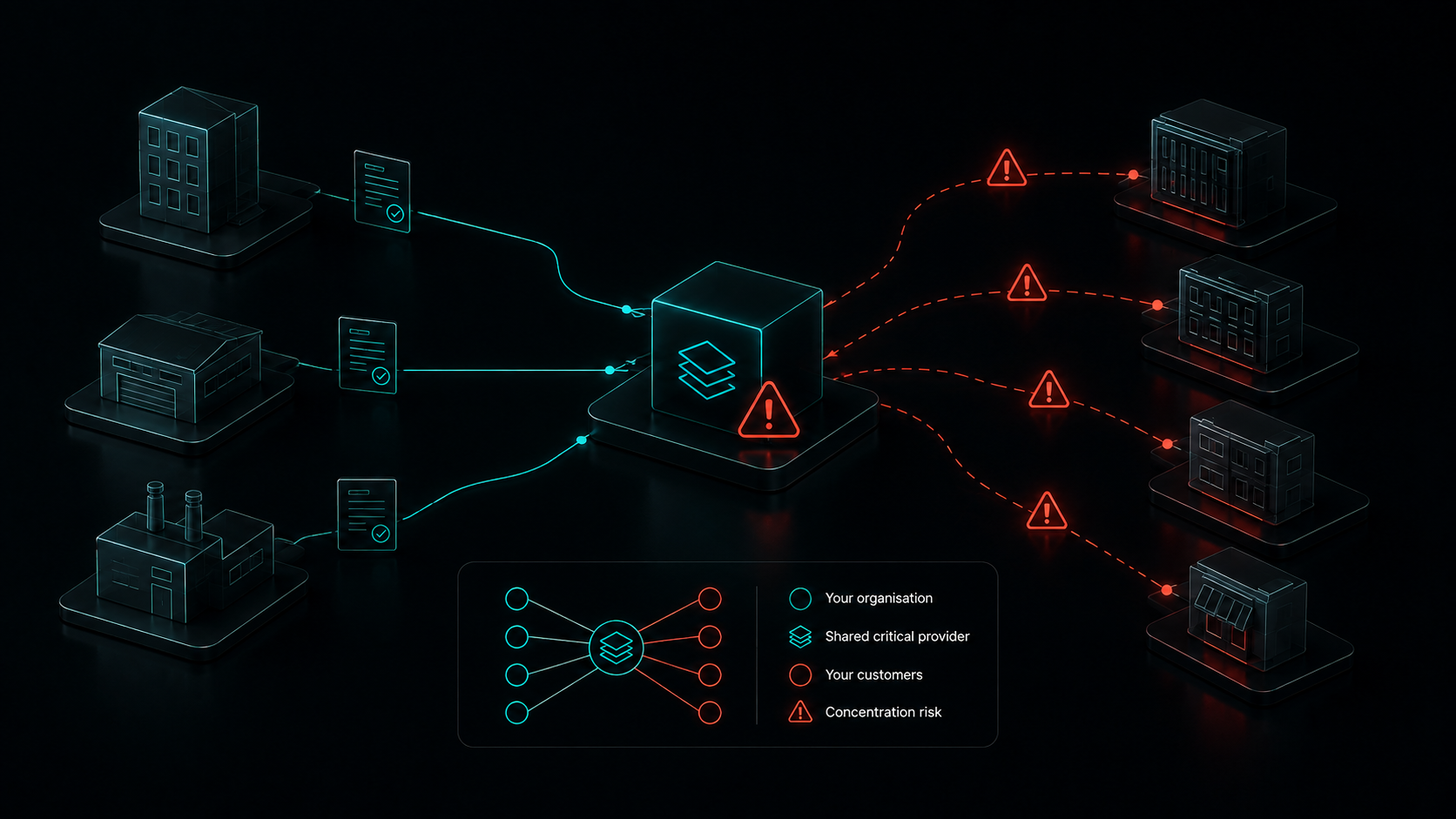
Understand how visible your supply chain really is, where concentration risks may exist, and how quickly you could identify affected suppliers during an emerging threat.
Take the Supply Chain Exposure Assessment →

Monthly research, case studies and practical guides you won't find anywhere else.
Join thousands of security managers turning their TPRM programmes into success stories.



.svg)