September 10, 2026
・
4
mins read
.png)
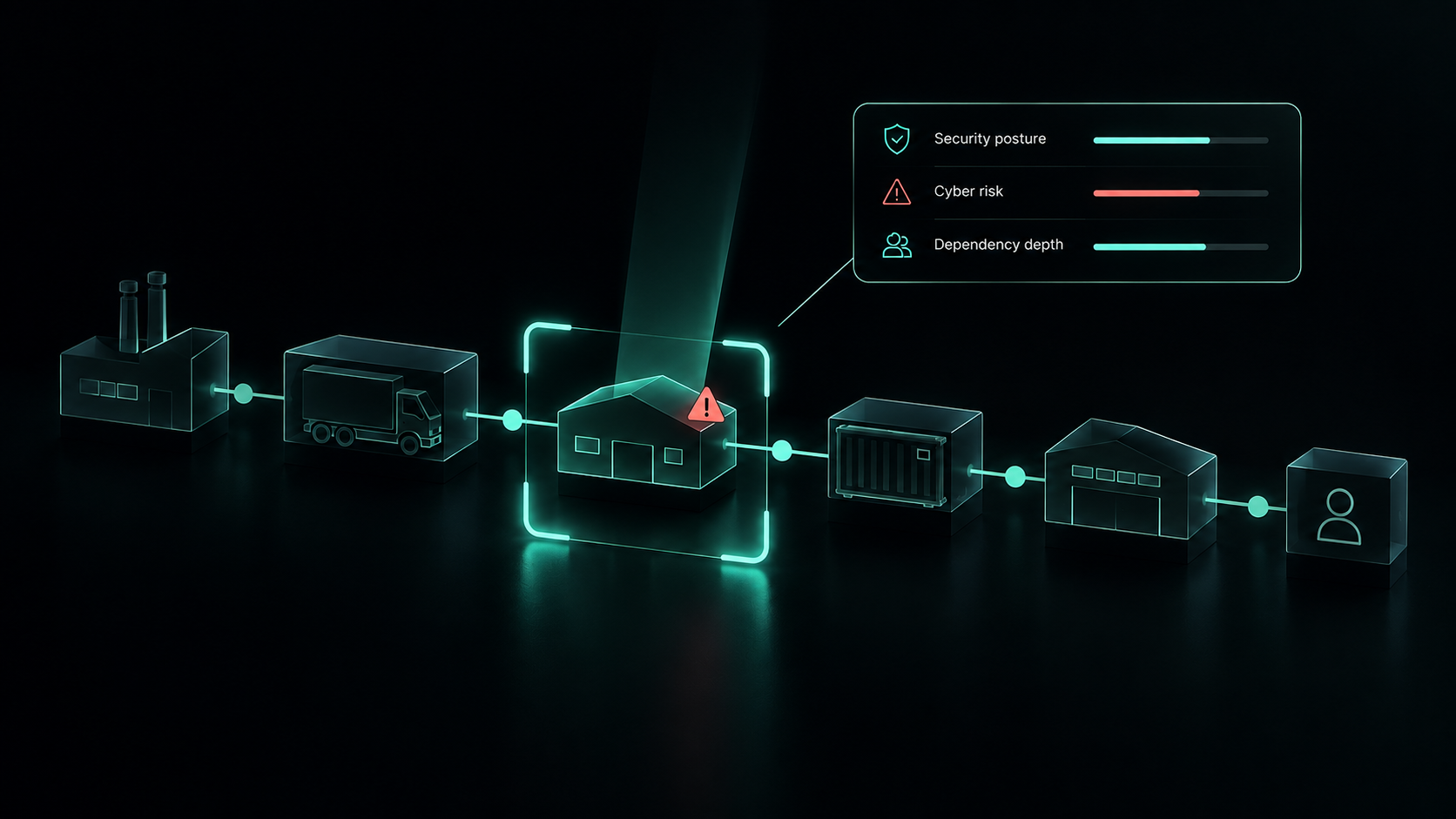
Attack Surface Management (ASM) was built to answer one question about an organisation's own perimeter: what does the outside world see when it looks at us? Security teams run it against their own domains, servers and cloud infrastructure to find exposures before an attacker does.
The same technique works just as well pointed outward, and a growing number of security teams now do exactly that, running an ASM-style scan against a supplier's internet-facing assets instead of their own, and treating the result as a proxy for how seriously that supplier takes security. It's an appealing shortcut: no waiting on a questionnaire response, no dependency on the supplier's cooperation, just a scan. This outward-pointing use of ASM is where the real confusion starts, because it increasingly gets marketed, and mistaken, as a form of third-party risk management (TPRM): the practice of assessing whether a supplier's overall security posture, governance, people, technical controls and resilience, can actually be trusted, based on verifiable evidence rather than a scan of what's publicly visible.
Both promise continuous visibility. Both can produce a score or a dashboard a security leader can show a board. And a growing set of tools, BitSight, UpGuard and SecurityScorecard among them, blend that outward-facing scanning with vendor risk workflows, which makes the line between "we scanned this supplier" and "we assessed this supplier" even harder to see from looking at a supplier rating or risk report.
But that distinction matters more than it might appear at first. When Risk Ledger's 2026 survey of 500 UK security and TPRM professionals asked what they considered the single biggest shortcoming in their current approach to TPRM, the top two answers were a lack of visibility into supply chain dependencies beyond direct third parties, and an inability to continuously monitor suppliers' internal security controls, the two things scanning was never built to do. Understanding exactly what each approach does do, and, just as importantly, what they are structurally unable to do, is what closes that gap.
This guide sets out where ASM ends, where TPRM begins, and where both fall short, namely in their ability to identify hidden concentration risks that only become visible across a shared supplier network. It also introduces a new approach that builds on both ASM and TPRM, but goes much further.
Attack Surface Management (ASM) is the continuous discovery, inventory and monitoring of every internet-facing asset an organisation owns, so security teams can find exposures before an attacker does. Unlike a one-off penetration test, ASM runs on an ongoing basis and covers assets a team may not even know it has.
ASM actually splits into two variants, and the difference matters for everything that follows. Cyber Asset Attack Surface Management (CAASM) works from the inside out, pulling data from tools an organisation already runs internally, its cloud accounts, endpoint protection, identity systems, to build a complete asset inventory. External Attack Surface Management (EASM) works from the outside in, with no internal access at all, discovering whatever's visible from the public internet the way an attacker would. That distinction is what makes EASM the variant relevant to this guide: it's the only one of the two that can be pointed at a supplier, because CAASM requires exactly the kind of internal access an organisation will never have into someone else's environment. From here on, "ASM" in this guide refers to EASM specifically, since that's the form of attack surface management that gets used, and sometimes misused, in third-party risk management.
That last point is what separates ASM from most other security disciplines. Shadow IT, forgotten subdomains, misconfigured cloud storage and orphaned test environments all sit outside the asset inventory most teams work from. ASM tools scan the open internet for anything connected to an organisation's known domains, IP ranges and certificates, then flag what's exposed and what's changed.
The output is a live map of the external attack surface: open ports, exposed services, expired certificates, unpatched software versions visible from outside, and misconfigurations an attacker could find with the same tools. What it does not do is tell a security team anything about the people, policies or internal controls behind those assets. An organisation can have a clean EASM scan and still have no multi-factor authentication on privileged accounts, no tested incident response plan, or a culture where phishing emails get clicked. ASM finds the front door. It has nothing to say about who has the keys, or whether anyone's watching the back door.
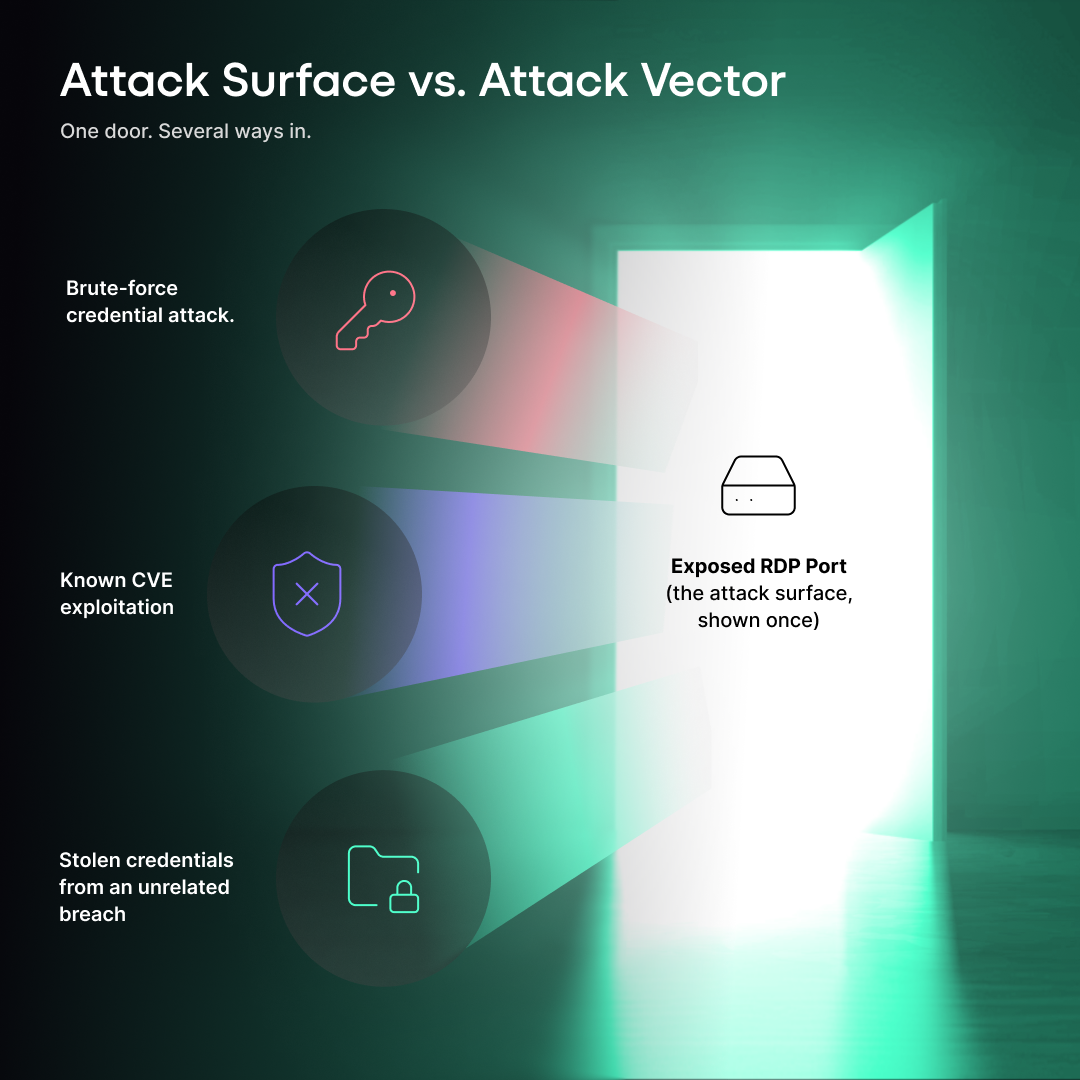
An attack surface is every point where an attacker could gain entry. An attack vector is the specific method they use to get through one of those points.
Take an exposed RDP (Remote Desktop Protocol) port on an organisation's own server. That open port is part of the attack surface — it's a point of entry that shows up on a scan. The attack vector is what an attacker actually does with it: a brute-force credential attack, a known RDP vulnerability, or credentials bought on a criminal marketplace after a previous breach. Same entry point, three different vectors, only one of which any scanner would flag in advance.
One vector deserves particular attention, because it doesn't require breaching an organisation's own perimeter at all: going in through a supplier instead. An attacker who compromises a supplier with trusted network access, shared credentials, or a software update mechanism doesn't need to find a way through the target's own defences — the supplier's compromise is the way through. This is what a growing share of major incidents actually look like, and it means an organisation's practical attack surface isn't bounded by its own perimeter. It extends into every supplier with a trusted connection into it.
This is also why a growing number of security teams now point ASM tools at their suppliers, not just at themselves — treating a supplier's external footprint as a proxy for how seriously that supplier takes security. It's an appealing shortcut: no waiting on a questionnaire response, no dependency on the supplier's cooperation, just a scan. Whether that shortcut actually tells you what you need to know is the question the rest of this guide answers.
Attack Surface Management finds assets. Vulnerability Management checks known assets for known weaknesses. They sound similar, get bundled together in vendor marketing, but answer genuinely different questions — and the gap between them widens further the moment either is pointed at a supplier rather than at your own organisation.
Vulnerability Management (VM) starts from an inventory a team already knows about — servers, endpoints, applications — and scans them against databases of known vulnerabilities (CVEs), producing a prioritised patching list. It assumes the asset is already on someone's radar, and it typically needs credentialed or agent-based access to do its job properly. That's straightforward inside your own environment. It's not something you can do to a supplier at all, because you don't have access to their internal systems to scan them credential-in-hand — which is exactly why VM stays an internal discipline and never becomes a supplier-assessment tool in its own right.
ASM starts one step earlier and doesn't have that access problem. It doesn't assume the inventory is complete, and it doesn't need permission to look: it goes looking for internet-facing assets from the outside, whether that's a marketing contractor's forgotten subdomain inside your own organisation or a supplier's exposed server you'd have no other way of seeing without their cooperation. That's precisely the asymmetry from Section 2 — ASM can be pointed outward at a third party with no dependency on them, while VM structurally cannot.
This ordering matters within your own organisation because VM can only protect what it's told to scan. A perfectly run vulnerability management programme, patching every known CVE on schedule, still leaves an organisation exposed if an entire server sits outside the asset inventory in the first place. ASM's job is to close that gap — to surface the unknown-unknowns before a VM programme can even start checking them. Pointed at a supplier, though, ASM isn't feeding into a VM programme at all, because there's no equivalent internal VM step happening on your side of that relationship. It's operating alone, answering a narrower question by necessity, not by choice.
In practice, inside your own perimeter the two are complementary rather than competing: ASM answers "what exists that we might not know about, and what's exposed?" while VM answers "of the things we know about, what's vulnerable, and in what order should we fix it?" A mature internal security programme needs both, in that sequence. Pointed at a supplier, only the first question is answerable from the outside at all — which is exactly the limitation Section 5 picks up when it looks at what happens once that single, narrow answer gets treated as sufficient supplier assurance on its own.
Most ASM tools scan one surface: the external one. Whether that tool is pointed at your own organisation or at a supplier, security teams typically think about exposure across three surfaces — and the asymmetry from Section 3 gets sharper still once you look at which of the three actually stays visible depending on whose perimeter you're standing outside of.
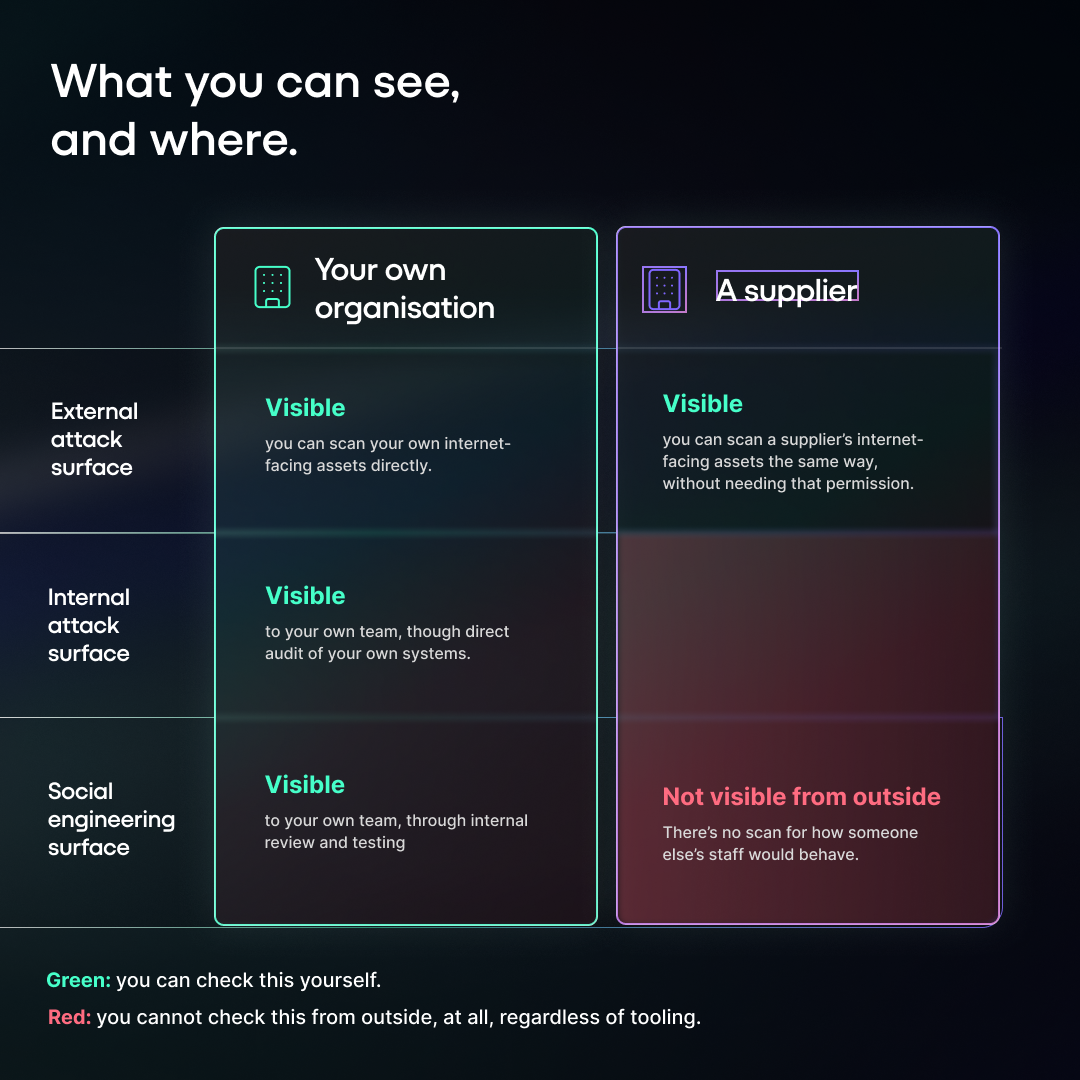
The external attack surface covers everything internet-facing: domains, subdomains, IP ranges, cloud storage buckets, APIs, exposed ports and public certificates. This is the surface ASM tools are built to map, and they do it well — continuously, at scale, without waiting for a manual audit. It's also the only one of the three surfaces that stays fully visible regardless of whose organisation you're scanning. You don't need a supplier's permission to see their exposed attack surface, for the same reason established in Section 3: ASM doesn't require credentialed access.
The internal attack surface covers everything inside the network perimeter once an attacker (or a legitimate but compromised credential) gets past the front door: internal segmentation, privileged access controls, lateral movement paths between systems, and how quickly unusual internal activity gets noticed. Inside your own organisation, this surface is at least reachable — your own security team can audit it directly. Point the same question at a supplier, and it disappears entirely. There's no scan that reveals whether a supplier's network is flat and unsegmented, because that question can only be answered by someone with access to how the network is actually built and run — which, by definition, isn't you.
The social engineering attack surface covers the human and procedural layer: how well staff recognise phishing attempts, how easily someone can talk their way past a helpdesk, whether privileged users go through background checks, and whether there's a tested incident response plan for when someone gets it wrong. This is consistently where real breaches start, inside an organisation or at a supplier. It is also the surface furthest from anything an external scan could ever touch, supplier or not — there is no port to scan for "would this person click a phishing email."
Put the three together and a pattern emerges that matters more with each section: assessing your own organisation, all three surfaces are at least testable, even if the last two require real internal audit work rather than a scan. Assessing a supplier, only the external surface is within reach by an outside tool at all. The internal and social engineering surfaces remain invisible to it, structurally, by design. That's not a limitation ASM can be improved to fix. It's the boundary of what any external, unauthenticated technique can ever tell you about someone else's organisation.
Managing that reach, for the surfaces you do have full access to, is what Continuous Threat Exposure Management (CTEM) is built for. Where ASM discovers what's exposed, CTEM is the ongoing cycle that turns discovery into action: scoping which assets and business risks matter most, prioritising exposures against actual business impact rather than raw technical severity, validating whether an exposure is genuinely exploitable, and mobilising the right team to fix it. It's a strong model for running that cycle across your own external, internal and social engineering surfaces, because it assumes what only holds true for your own organisation — that you have the access needed to scope, validate and remediate in the first place.
That assumption is exactly where CTEM stops being useful the moment you turn it toward a supplier. You can't scope a supplier's internal segmentation if you can't see it. You can't validate whether their exposed service is genuinely exploitable without access to test it properly. You can't mobilise their team to fix anything — you can only ask them to. CTEM, like ASM and VM before it, is an organisation-centric discipline, built around the reach you actually have. The moment the question shifts from "how do we manage exposure across our own three surfaces" to "how do we get any confidence in a supplier's," a different discipline has to take over — one built from the start around the fact that you don't have direct access, and never will. That's third-party risk management, and it's where this guide turns next.
The gap is clear by now: external scanning can't see a supplier's internal controls, and it was never going to. What's less obvious is why security teams keep leaning on it as if it could, and the answer isn't confusion about what scanning does. It's resource pressure. A team managing hundreds or thousands of suppliers on limited headcount doesn't have the option of a deep internal audit for every one of them, and a fast, automated scan is genuinely the only thing that scales to that number. The shortcut from Section 3 isn't a mistake teams fall into by accident; it's often the only lever available under real constraints.
Scanning was never meant to be the whole of third-party risk management, though it's increasingly treated as a quick compliance fix for it. TPRM, at its core, is the practice of assessing whether a supplier's security posture, its governance, people, and technical controls, can be trusted with the access and data it's given. Traditionally, that assessment runs through questionnaires and supplier self-attestations: a supplier answers structured questions about its controls, submits supporting evidence such as policies or certifications, and a TPRM team reviews that evidence and follows up on gaps. Done properly, this reaches exactly where scanning can't: whether MFA is actually enforced on privileged accounts, whether an incident response plan has been rehearsed, whether staff go through security awareness training. It's the only one of the two methods built to ask about the internal and social engineering surfaces from Section 4 at all.
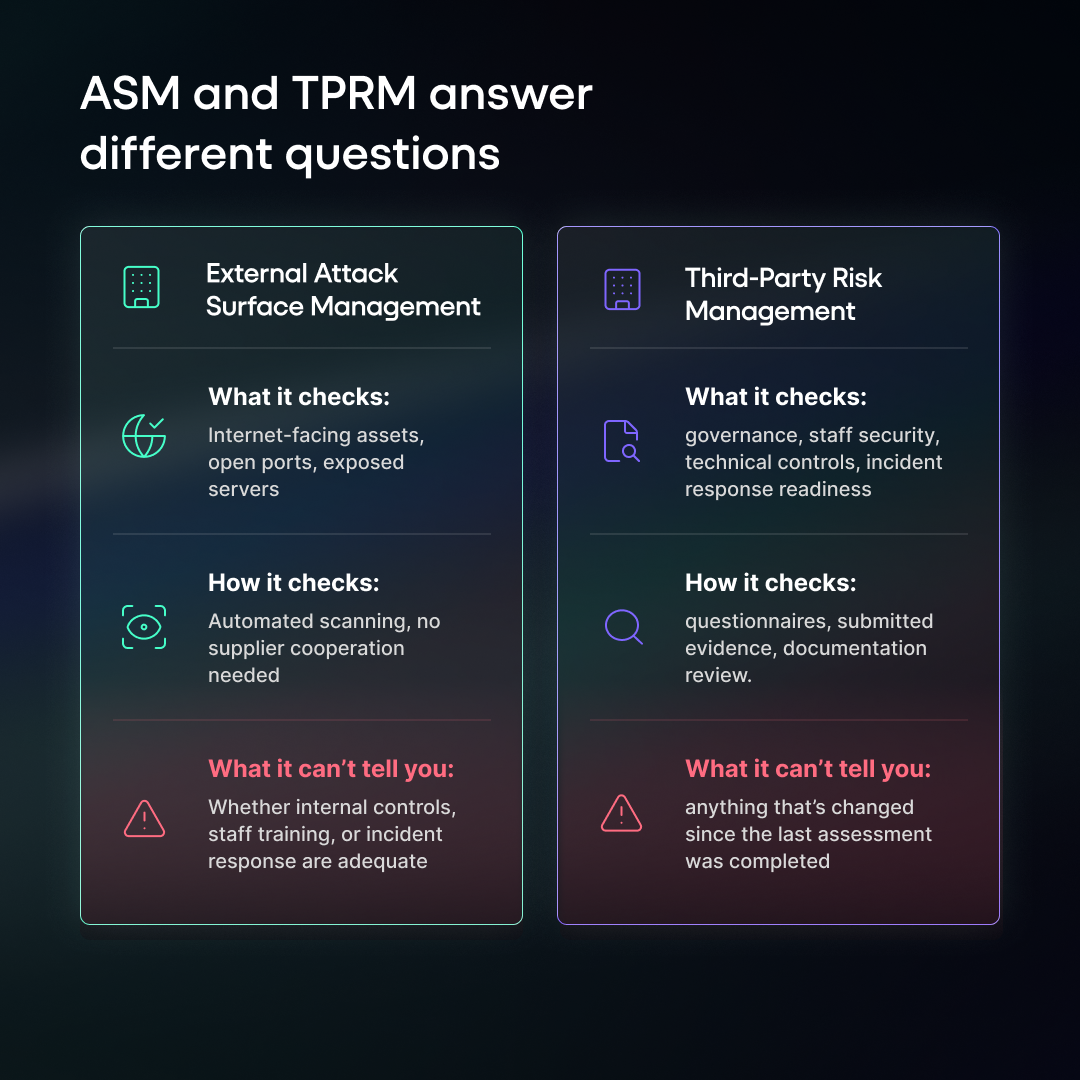
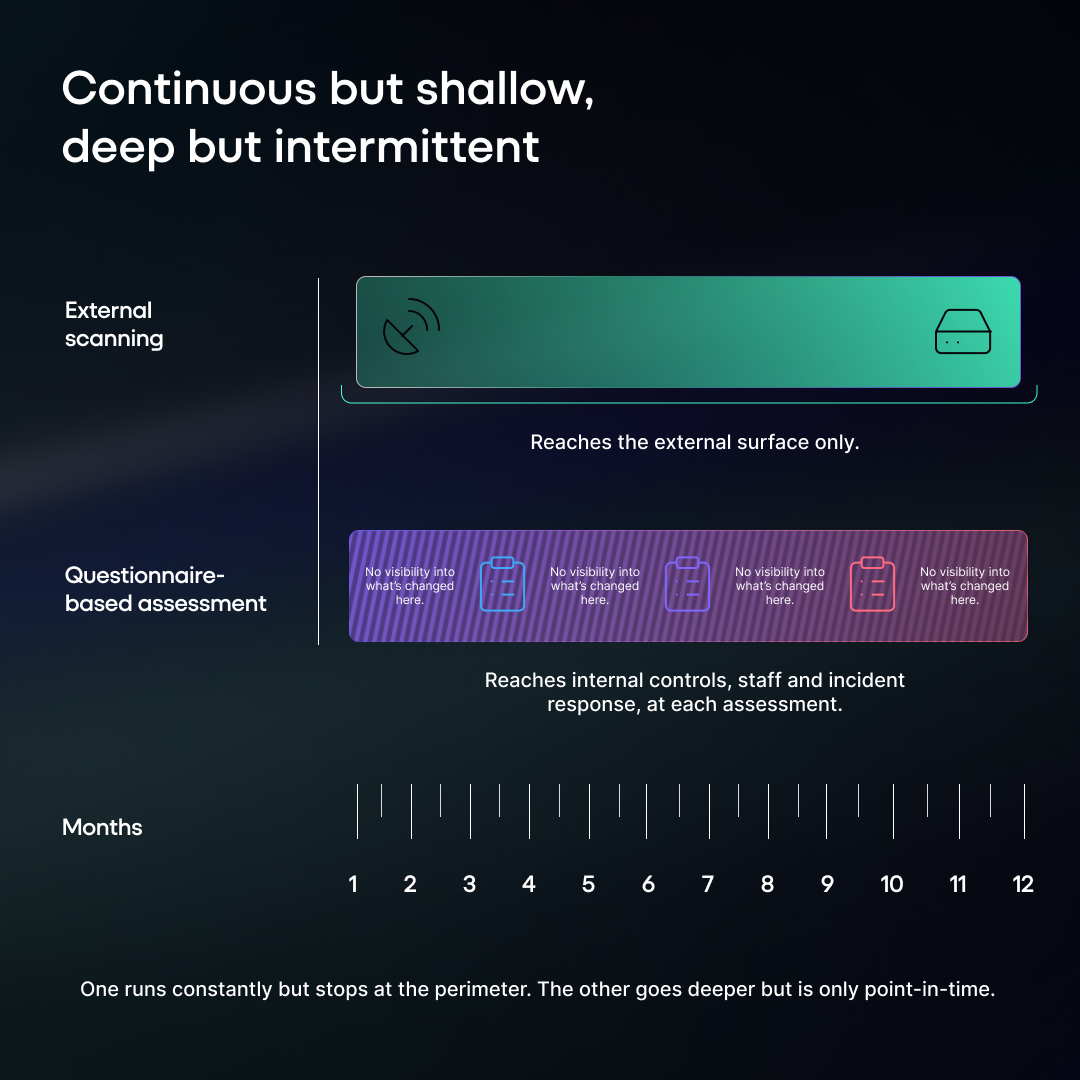
But it comes with a different failure mode. A questionnaire-based assessment is thorough in the moment it's completed, and can be out of date the moment after. Repeating that process across a supplier base numbering in the hundreds or thousands, at the depth needed to be meaningful, takes more time and resource than most TPRM teams have. Between one assessment and the next, a supplier's security posture can change substantially: a control gets disabled, a key person leaves, an update lapses, and nothing in a point-in-time questionnaire cycle will surface it until the next review comes around, if it comes around at all before an incident occurs.
Scanning and questionnaires end up as mirror images of each other's weaknesses. Scanning is continuous but shallow: it runs constantly, but only ever sees the external surface. Questionnaire-based assessments are deep but intermittent: they can inform on the adequacy of internal security controls, but only provide a point-in-time snapshot that ages badly from the day it's submitted.
Risk Ledger's 2026 survey of UK security and TPRM professionals puts numbers on both problems. Only 38% of organisations can complete security due diligence on a new supplier within two weeks, 34.6% need three weeks or more, and 12% take longer than a month. That's the onboarding end of the cycle; reassessment tends to follow the same rhythm, which is exactly why TPRM is so time-consuming and resource-intensive and why there are generally large gaps between reviews. When asked to name the single biggest shortcoming in their current approach to TPRM, among the most widely cited were an inability to continuously monitor suppliers' internal security controls (19.8%) and the lack of human and financial resources committed to TPRM (15.4%). Three different symptoms of the same underlying constraint: not enough time, people or budget to keep pace with how many suppliers need watching and how often.
The result shows up in outcomes, not just process. Supply chain incidents remain widespread even where TPRM programmes are active: 82.4% of surveyed organisations experienced at least one in the past year, and thus 86% still rank supply chain incidents among their top three areas of concern for 2026. Deep assessments are happening, but they are apparently not translating into fewer incidents at the degree they should.
That gap is showing up in how security leaders themselves rate the discipline. Confidence in traditional TPRM's effectiveness has fallen year on year: only 27.8% of respondents now consider it very effective at reducing supply chain cyber risk, down from 37.2% in 2025, even as 60.4% still call it somewhat effective. Traditional TPRM does address a supplier's internal security posture in a way scanning never can. It's nonetheless also increasingly judged, as insufficient to keep organisations safe, and the data suggests that judgement is fair.
Even taken together, though, scanning and questionnaire-based TPRM share a blind spot neither one touches: both stop at the direct supplier. Neither was built to look at who and what tools and services that supplier itself depends on, and the 2023 MOVEit breach is the clearest illustration of why that matters. Many of the organisations affected never used MOVEit Transfer themselves. They were hit because a supplier, or a supplier's supplier, did, and that dependency sat entirely outside what either an external scan or a direct-supplier questionnaire would ever have surfaced. The risk didn't originate at a third party at all. It arrived through a fourth or fifth party nobody at the affected organisation had directly assessed, or in many cases, had ever known existed.
Risk Ledger's 2026 survey shows how widespread that blind spot still is. Only 30% of UK security and TPRM professionals report full visibility into their entire sub-contractor chain. A further 50.2% see only as far as their most critical suppliers' direct sub-contractors, 16% have partial visibility at best into such fourth parties, and 3% have no visibility beyond their direct third parties at all. That's the ceiling on what even a well-run TPRM programme, combined with scanning, can currently see. What sits past that ceiling, and why it matters more than a simple visibility gap, is what this guide turns to next.
A visibility gap sounds like a problem of degree: see further down the chain, and the problem shrinks. Concentration risk is a different kind of problem entirely, because it isn't about how far you can see. It's about what happens when several things you can't fully see turn out to be the same thing.
Individual concentration risk occurs when several of an organisation's own direct suppliers all depend on the same fourth party, or when a cluster of fourth parties further down the chain all depend on the same fifth party. If that shared dependency fails, multiple parts of one organisation's supply chain go down at once, even though each supplier looked independently sound when assessed on its own.
Systemic concentration risk is the sector-wide version of the same pattern: a supplier widely used across an entire industry, whose disruption doesn't just hit one organisation but cascades across many at the same time. The mechanism is identical in both cases. What changes is how many organisations get caught in the blast radius, and MOVEit is again the clearest illustration: the same underlying dependency sat beneath many organisations' supply chains at once, which is precisely what turned one vendor's breach into a cross-sector incident rather than an isolated one.
Neither scanning nor questionnaire-based TPRM, however well resourced, is built to catch this, for a structural reason rather than a resourcing one. An organisation's own assessment, no matter how deep, only ever looks down its own chain. It has no way to see whether its suppliers' dependencies overlap with those of ten or twenty other organisations in the same sector, because that comparison requires data those other organisations hold, not data any single organisation could gather on its own. The WEF's Global Cybersecurity Outlook 2026 found that 65% of large organisations now cite third-party and supply chain risk as their primary resilience challenge, up from 54% the year before, which suggests this blind spot is increasingly recognised even where it isn't yet solved.
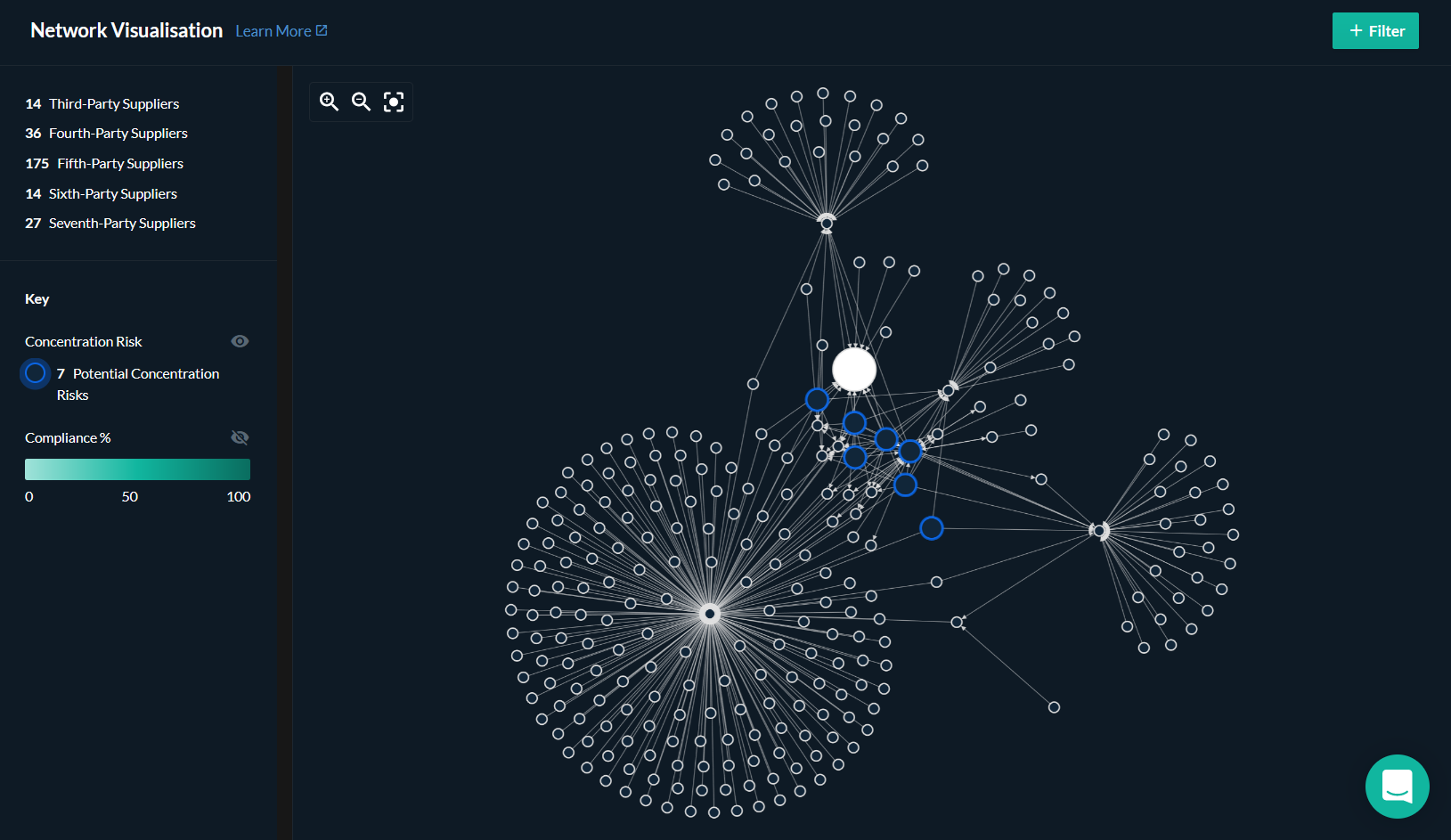
This is precisely the gap Risk Ledger's community data makes visible. When 26 UK government bodies mapped their shared supply chains on Risk Ledger, the platform surfaced 1,264 potential concentration risks across their combined nth parties, 224 of them rated critical at the third-party level alone, meaning an incident at any one of those suppliers was likely to disrupt essential services at multiple public sector organisations simultaneously. A parallel community of 30 UK financial institutions found 727 third-party concentration risks, 288 of them critical. None of this was visible to any single organisation looking only at its own supplier data; it only became visible once peers pooled standardised supplier profiles on a shared network. This is the core mechanic behind Active Supply Chain Security (ASCS): concentration and systemic risk are collective problems, and they require collective visibility to solve.
Everything in this guide so far has been about capability: what ASM can see, what TPRM adds, where both still fall short. It worth looking at existing and especially new regulations, because these are increasingly turning that capability gap also into a compliance gap. What used to be a best-practice recommendation, i.e. look beyond your direct suppliers, is becoming a legal requirement in some jurisdictions.
ASM and external scanning earn their keep against the baseline frameworks most security teams already know. NIST's Cybersecurity Framework and SP 800-53 lean on continuous monitoring and asset inventory as foundational controls, and you can't secure what you haven't found, which is precisely what ASM is built to fix. PCI DSS wants regular vulnerability scanning of anything touching cardholder data. HIPAA and GDPR both expect an organisation to know what systems process regulated data and to demonstrate reasonable security around them. A good ASM programme genuinely helps satisfy all four. What none of them ask for is visibility past a direct supplier, so none of them are where the gap this guide has been describing actually shows up.
That gap starts to show once you move from general compliance frameworks to rules written specifically around operational resilience and supply chain dependency. In the US, the Federal Reserve, FDIC and OCC issued joint interagency guidance on third-party relationships in June 2023, replacing each agency's older, separate rules with a single risk management lifecycle covering planning, due diligence, contracting and ongoing monitoring. It explicitly calls out the risk of a bank relying too heavily on one third party, or on several relationships that quietly trace back to the same underlying provider, and expects firms to account for that. A related set of practices from 2020, aimed at the largest US banks, pushes further still, asking firms to map their most critical operations and the dependencies sitting underneath them. Both are real, substantive requirements, and neither is satisfied by a scan. But both are also still framed around what a single bank can see about its own supply chain. Neither gives that bank a way to know whether the dependency it's just mapped is one it shares with twenty other banks, because that comparison sits outside what either instrument was built to ask for.
The EU and UK have taken that extra step. DORA, in force since January 2025, requires financial entities to assess ICT concentration risk explicitly, reaching past direct providers into subcontractors and deeper-tier dependencies, and it goes further than the US guidance by giving European supervisors the power to directly designate and oversee the technology providers judged systemically important enough to warrant it. That's no longer a firm managing its own risk in isolation; it's a regulator building a view across an entire sector. The UK is heading the same way. The Cyber Security and Resilience Bill has moved on since our 2026 report went to print: having cleared the Commons, it's now before the House of Lords, passed Second Reading on 14 July 2026, and enters Committee Stage on 1 September 2026, with Royal Assent expected before the year is out. It introduces a Designated Critical Suppliers regime, extending statutory cyber duties directly to suppliers whose disruption could cause widespread harm, and for the first time brings managed service providers and data centres into scope.
Line all of this up and the split is the same one Section 6 already drew, just showing up again at the regulatory level instead of the operational one. The US has real, enforceable requirements for a firm to manage its own individual concentration risk. The EU and UK have gone a step further, building sector-wide regimes aimed at systemic risk, the kind that doesn't become visible until dependencies are compared across many organisations at once. For a security team operating across all three jurisdictions, that's not a gap to note and move past. It's a gap worth planning around now, because it isn't staying this way for long.
The vendor landscape offering services in ASM, TPRM and beyond, splits into three categories, and the confusion buyers run into usually comes from the middle category being marketed as if it belongs in the third.
Pure-play ASM tools
CyCognito, Rapid7, and similar platforms do one thing: continuously discover and monitor an organisation's own internet-facing assets. They don't produce supplier scores, don't manage questionnaires, and aren't built to assess a third party's internal controls. As Section 2 covered, nothing stops a team pointing one at a supplier instead, but that's an informal use of a tool built for something else, not a designed TPRM capability.
Security ratings and workflow platforms
BitSight, UpGuard, SecurityScorecard sit in the genuinely useful middle. All three continuously scan the public internet to produce an externally derived rating, and all three now layer some form of vendor workflow on top: questionnaire distribution, document collection, remediation tracking. BitSight's version of this, its Trust Management Hub, is worth describing in some more detail. It's a secure repository where a supplier uploads documents it's already prepared, SOC 2 reports, ISO certifications, past questionnaire responses, and shares them with clients on request. It thus acts like a trust centre, and that's the right label: sharing is supplier-initiated, updates propagate when the supplier chooses to push them, and different clients can still send the supplier different, tiered questionnaires through BitSight's separate assessment product. It's a well-organised repository with a sharing workflow attached, not a single standardised profile answered once against one common set of questions.
The Network-First Model
That distinction is the whole reason a genuinely standardised framework matters. When every supplier on a network answers the same structured set of questions, every organisation reading that profile is reading the same language of risk. A supplier's control maturity becomes directly comparable to another supplier's, because both were assessed against the same baseline, not against whatever mix of templates two different clients happened to send. That comparability is what makes genuine collaboration between organisations possible in the first place, it's the precondition for the concentration-risk mapping described in Section 6, because overlaying supply chain maps only works if the underlying assessments mean the same thing across every participant.
It also changes the economics of assurance on both sides. For the assessing organisation, one standardised profile shared across the network replaces the resource-heavy work of running a separate, bespoke assessment for every supplier relationship, exactly the constraint Section 5 traced back to limited headcount. For the supplier, it replaces answering dozens of slightly different questionnaires from dozens of different clients with maintaining one profile, kept current, that every connected client can see. That's a direct answer to supplier fatigue, a persistent problem across the TPRM literature, and in practice it tends to produce better supplier engagement rather than worse, because a supplier asked to maintain one thing well engages more willingly than one asked to repeat the same disclosure in ten different formats. And because updates to that one profile are visible to every connected organisation automatically, rather than propagated only when a supplier chooses to push a document out, the assurance stays current across the whole network rather than only for whichever client happened to ask most recently.
There's a second-order effect worth naming too. A network built this way doesn't just make the assessing organisation individually safer. Because the same supplier assessment is shared and current across every connected client, a control weakness or a change in posture becomes visible to the whole network at once, not just to whoever last ran a review. That's closer to a form of herd immunity for the network than to any single organisation's dashboard getting better: the more of the network that's connected and current, the harder it becomes for a shared weak point to stay invisible to everyone in it.
That's the mechanic that the concentration-risk data actually depends on, and it's the point where this category genuinely diverges from category two. Risk Ledger's network model provides the answer: organisations comparing their own supply chain data with their peers', which is what turned 26 UK government bodies' individual assessments into 1,264 shared concentration risks nobody could have found alone.
None of this makes categories one and two low-value. A pure ASM tool is still the right choice for perimeter discovery. A ratings-and-workflow platform is still a real improvement in addition to spreadsheets and email for organisations not yet ready for a shared network model. What matters is exploring the right tool for the job actually in front of you, and knowing which job each category was built for.
Attack Surface Management, third-party risk management, and Active Supply Chain Security answer three different questions, and the confusion between them usually comes from expecting one to answer all three.
ASM answers: what does the outside world see when it looks at our internet-facing assets, or our suppliers'? It does this well, continuously, and at a scale manual audits can't match. It has nothing to say about internal controls, staff behaviour, or incident response readiness, because it was never built to look there.
TPRM answers: can this supplier be trusted to manage risk well, based on verifiable evidence of their governance, people and technical controls? Done properly, it goes where ASM can't. Done badly, using annual questionnaires and treating a clean external scan as sufficient assurance, it produces documentation without producing confidence — a gap our 2026 survey of UK security and TPRM professionals shows plainly: confidence in traditional TPRM's effectiveness has fallen year on year, even as supply chain incidents remain stubbornly common.
Neither answers the third question: where do our supplier relationships overlap with everyone else's in our sector, and what happens if a shared dependency fails? That's what individual and systemic concentration risk look like in practice, and it only becomes visible through standardised, shared supplier data across a network — the mechanic behind Active Supply Chain Security.
None of these tools is wrong. Each is answering a narrower question than buyers often assume. Getting the distinction right is what determines whether an investment closes a real gap or simply adds another dashboard.
For the full UK data behind these findings, read Every Link Matters: The State of Supply Chain Security 2026 — UK Edition.
Is external scanning enough for third-party risk management?
No. External scanning shows what's exposed on a supplier's perimeter but has no visibility into internal controls, staff behaviour or incident response readiness. Why external scanning alone isn't enough for TPRM →
How do you actually achieve continuous monitoring in TPRM, beyond a scan?
Genuine continuous monitoring combines regular reassessment of a supplier's internal controls with real-time notification when something changes — not just a periodic external scan. How continuous monitoring works in TPRM →
Why is traditional TPRM struggling to keep up in 2026?
Bilateral, questionnaire-led assessments weren't built for the scale and interdependence of today's supply chains, and confidence in their effectiveness is falling as a result. Why TPRM is broken — and what comes next →
What is Active Supply Chain Security, and how is it different from TPRM?
ASCS builds on TPRM with standardised, reusable supplier data and network-level visibility, so concentration risks that are invisible to any single organisation become visible across a shared community. Active Supply Chain Security explained →
How should we prioritise which suppliers need the most scrutiny?
Not every supplier carries the same risk, and treating them all identically wastes assurance effort where it matters least. How to prioritise supplier assessments →
What hidden supplier dependencies could be increasing our risk right now?
Fourth-party and shared-provider dependencies often sit well outside what a direct-supplier assessment ever uncovers. What hidden supplier dependencies could increase your risk →
Where can I see the full UK data behind this article?
Our 2026 report covers incident prevalence, onboarding speed, visibility gaps and incident response readiness across 500 UK security and TPRM professionals. Read Every Link Matters 2026 →
Is ASM the same as third-party risk management?
No. Attack Surface Management continuously discovers and monitors an organisation's internet-facing assets. Third-party risk management assesses whether a supplier's overall security posture — governance, people, technical controls and resilience — can be trusted, based on verifiable evidence. ASM can support one input into a TPRM programme, but it isn't a substitute for it.
Does ASM cover my supply chain?
Only partially. An ASM tool can scan a supplier's public-facing assets in the same way it scans your own, but that only reveals the external attack surface — one of three surfaces covered in Section 4. It has no visibility into a supplier's internal controls, and none at all into how that supplier's own suppliers might create shared dependencies across your ecosystem.
What's the difference between attack surface management and vulnerability management?
ASM finds assets, including ones you didn't know you had. Vulnerability management scans known assets for known weaknesses and prioritises patching. ASM comes first in the sequence — you can't patch what you haven't found.
Can external scanning replace supplier questionnaires?
No. Scanning shows what's exposed on a supplier's perimeter; it can't confirm whether MFA is enforced, whether staff are trained to spot phishing, or whether an incident response plan has ever been tested. Questionnaires and verified internal-control data cover ground that scanning structurally cannot reach.
What's the difference between individual and systemic concentration risk?
Individual concentration risk occurs when several of an organisation's own suppliers depend on the same fourth party. Systemic concentration risk is the sector-wide version — a supplier widely shared across an industry, where disruption cascades across multiple organisations at once. Neither is visible to a single organisation looking only at its own supplier data.
Do BitSight, UpGuard and SecurityScorecard count as ASM tools or TPRM tools?
They sit in a hybrid category: all three produce an externally derived security rating similar to an ASM scan, but pair it with vendor risk workflow tooling such as questionnaire management. The rating itself still relies on externally observable signals rather than verified internal controls, so the same gap covered in Section 5 still applies.
%20-%20thumb.png)


Monthly research, case studies and practical guides you won't find anywhere else.
Join thousands of security managers turning their TPRM programmes into success stories.

.svg)