October 16, 2026
・
25
mins read
.png)
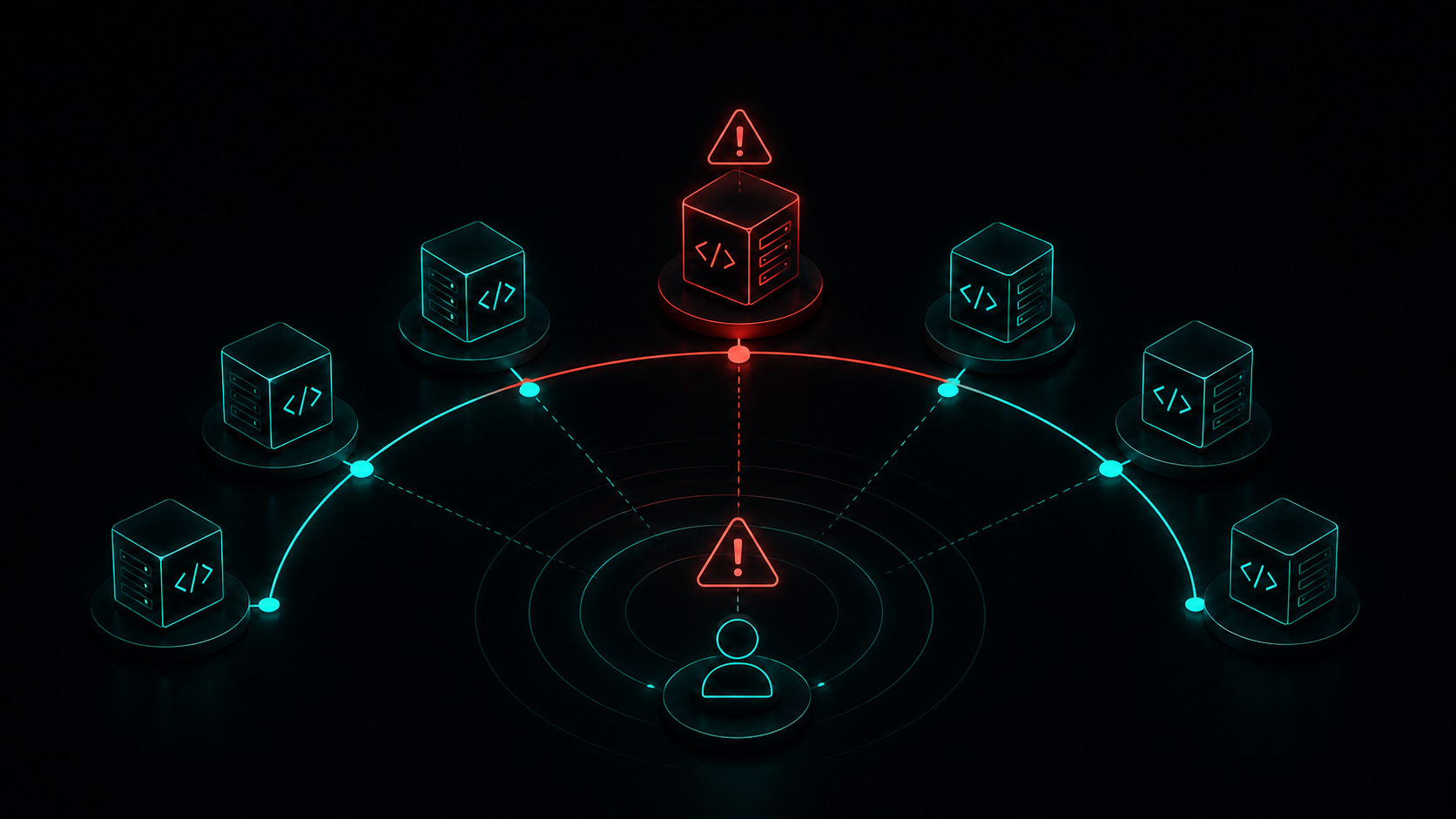
When a vulnerability or supplier incident becomes public, the instinct is to ask everyone at once. It feels thorough, but without a structured way to make sense of what comes back, it produces hundreds of responses to sort through instead of a clear answer about the suppliers that actually matter.
Even once responses start coming in, most organisations can't tell which ones actually matter, or what to do about them.
 Emily Hodges
COO, Risk Ledger
Emily Hodges
COO, Risk Ledger
It's bad for the suppliers, who are often fielding the same question from dozens of other customers at the exact moment they should be focused on fixing the problem, if they have one. And it's bad for the organisation sending it, because there was no way to know in advance which suppliers were actually relevant to this specific threat. The responses come back unstructured, at volume, and most of them won't tell you anything useful.
The alternative is knowing who to prioritise before you look at a single reply.
Organisations that have already mapped which suppliers are critical to them, and which hold their most sensitive data, don't need to draft a different message for everyone. They can send the same three questions out broadly, then use that mapping to decide whose response needs attention first. That's the difference between a targeted response and an unstructured one.
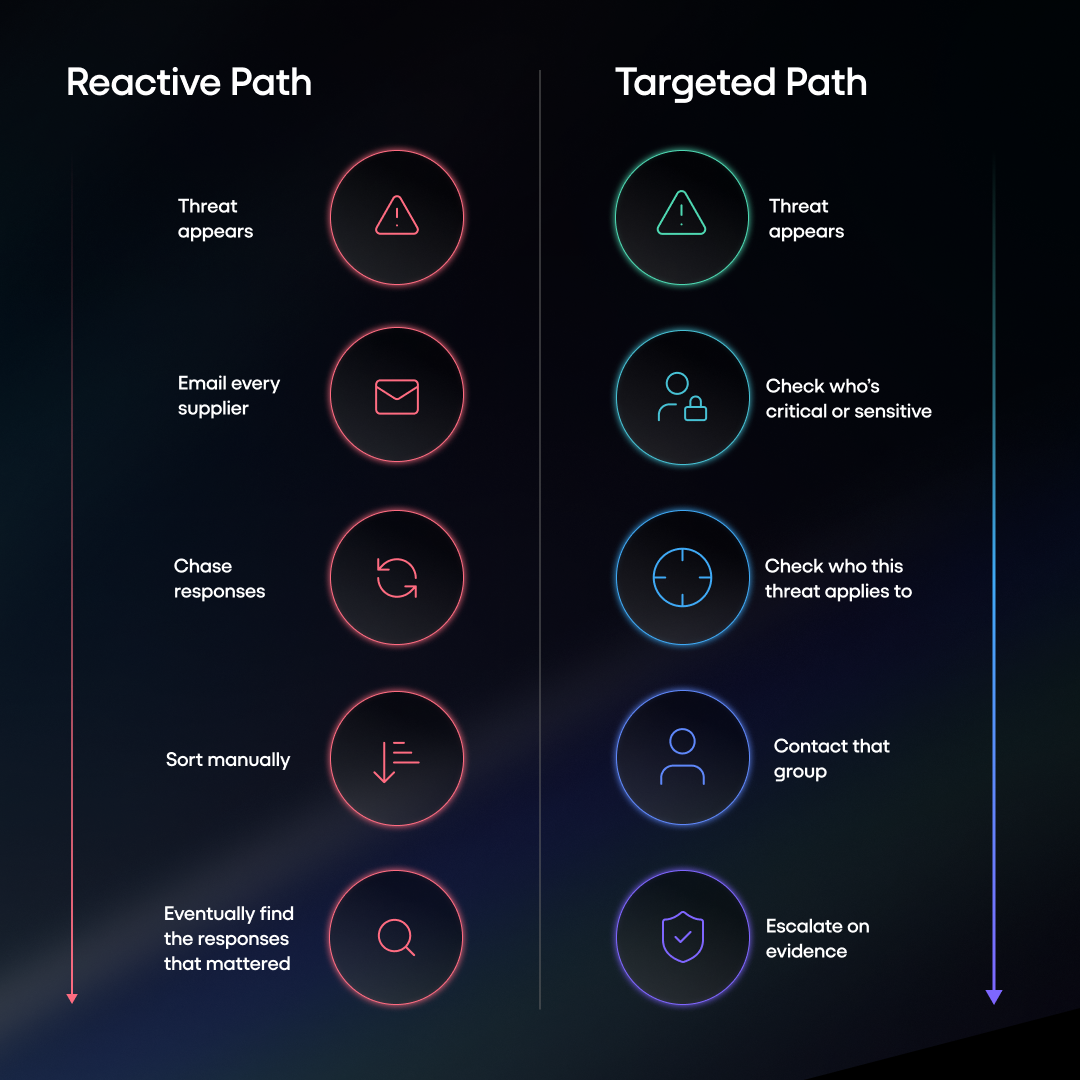
Without a platform, contacting suppliers costs time, so the criticality and sensitivity work has to happen first. You work out who matters, then reach out only to them.
With Risk Ledger, every connected supplier is asked the same three questions automatically the moment a threat is published. There's no per-supplier cost to reaching everyone, so the criticality and sensitivity work happens on the way back instead, deciding which responses get looked at first.
Same inputs, different order. What changes is whether that knowledge decides who gets asked, or which answer gets read first.
The starting point isn't a list of suppliers, it's the business. This applies whether that understanding decides who you contact or decides which replies you look at first.
This is the same exercise as everyday supplier prioritisation, just compressed. During an incident, the understanding of a supply chain environment needed to prioritise contact is the same understanding needed to run a supply chain programme day to day: what's critical to the business, what's sensitive, and which suppliers those things are outsourced to.
The only thing that changes is the timescale. Outside an incident, that mapping happens as ongoing risk management. Inside one, it has to already exist, because there's no time to build it from scratch while a threat is live.
If that mapping doesn't already exist, your only option is to send an email to the whole supplier database. And even once responses start coming back, there's no way to judge which ones matter or what to do about them, because the context that would make sense of a reply was never established in the first place.
This is the same groundwork covered in our guide to identifying critical suppliers. Worth doing before an incident, not during one.
Business criticality and threat relevance are two different questions, and a supplier can score high on one and zero on the other.
A supplier can be highly critical to the business and completely unaffected by a specific vulnerability, because it simply doesn't run the affected technology. Equally, a supplier that isn't on anyone's critical list can still matter enormously for this particular threat, if it happens to use the software in question, hold sensitive data, or sit somewhere in the affected path.
This is why standing criticality tiers aren't enough on their own during an active threat. Severity tells you how bad a vulnerability could be in theory. Applicability tells you whether it's actually relevant to a given supplier. A critical supplier that doesn't use the affected technology isn't a priority for this threat, whatever its usual tier says. A lower-tier supplier that does use it, and holds meaningful data or access, might need contacting immediately.
The two questions have to be asked together: does this supplier matter to the business, and does this specific threat apply to them.
Answering only the first question and skipping the second is how organisations end up contacting the wrong suppliers first, or missing the ones that actually need a response.
Prioritisation during an incident, whether it happens before outreach or once responses land, runs on the same two dimensions as everyday supplier risk. The time scale is just accelerated.
For a specific threat, that becomes two questions asked together: how much would it matter to the business if this supplier were affected, and how likely is it that this specific threat actually applies to them?
A supplier scores high on the first if they support a critical service or hold sensitive data. They score high on the second if they use the affected technology, sit in the affected path, or are otherwise plausibly exposed to this particular threat.
Keep the email itself simple. The three questions that matter are the same every time, regardless of what kind of threat triggered the outreach.
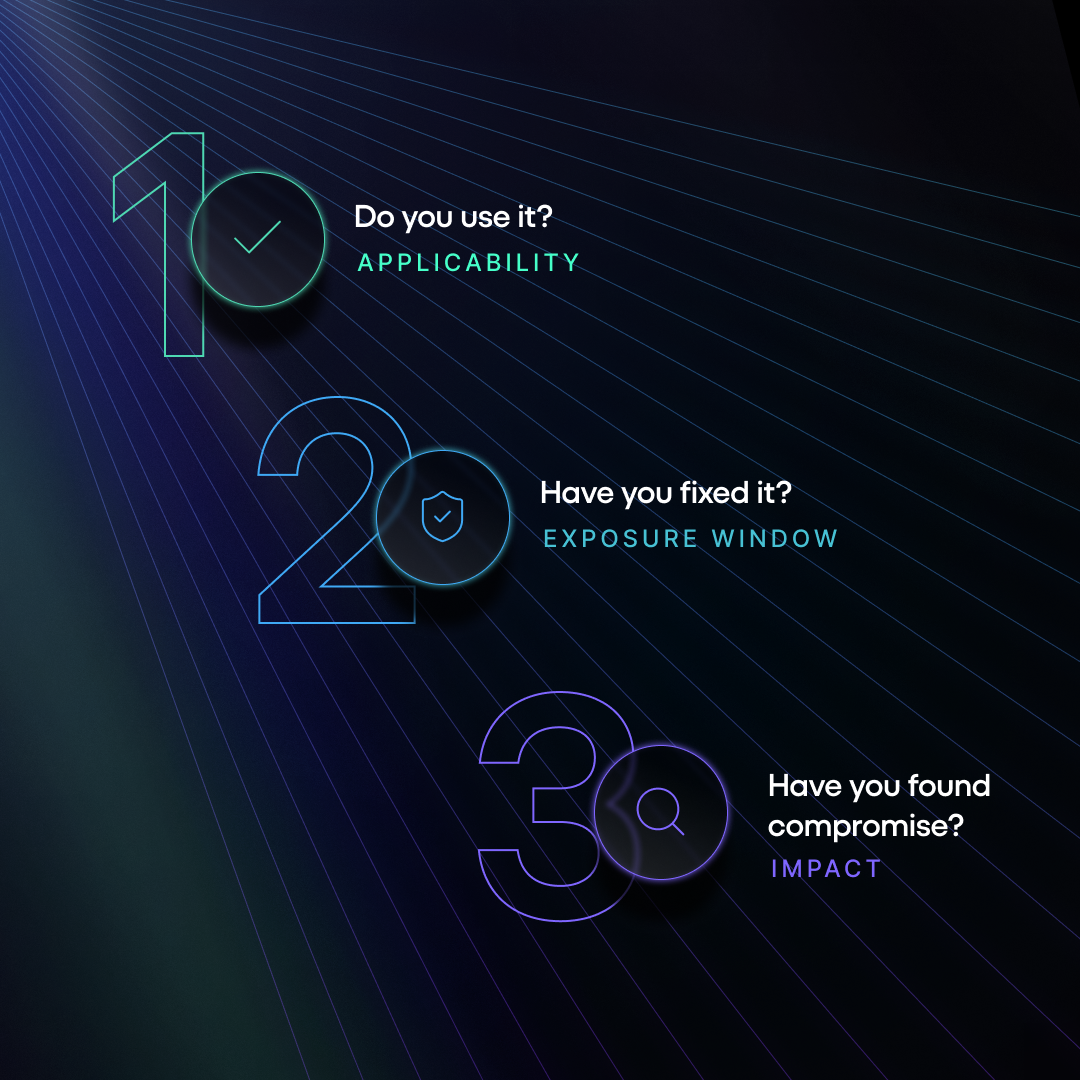
Ask whether the supplier uses the affected product, service or technology. That tells you if the threat is even relevant to them. Ask whether they've fixed it, or have a timescale for fixing it, if they do use it. That tells you the exposure window, how long the problem has existed and how much longer it's likely to run. Ask whether they've found any evidence of compromise. That tells you whether exposure has already turned into something worse.
Three questions, three distinct pieces of information: applicability, exposure window, and impact. Nothing else needs to go in the first message. Adding more slows down the answer without adding anything you can act on yet.
Tone matters as much as content. A supplier dealing with a live incident, or a threat that might turn into one, is likely fielding the same question from several other customers at once. The question is legitimate, but arriving as one of dozens of near-identical emails at the worst possible time isn't helpful to either side. Keep the email direct and specific rather than open-ended, and make clear what you need back and by when.
Most suppliers who deal with this regularly prepare for exactly this scenario. A standard response, published on a status page or briefed to frontline support teams, means the supplier isn't drafting a bespoke answer for every customer that asks. If a supplier already has something like this published, checking it directly is often faster than waiting for a reply to an individual email, and it's worth checking before sending one.
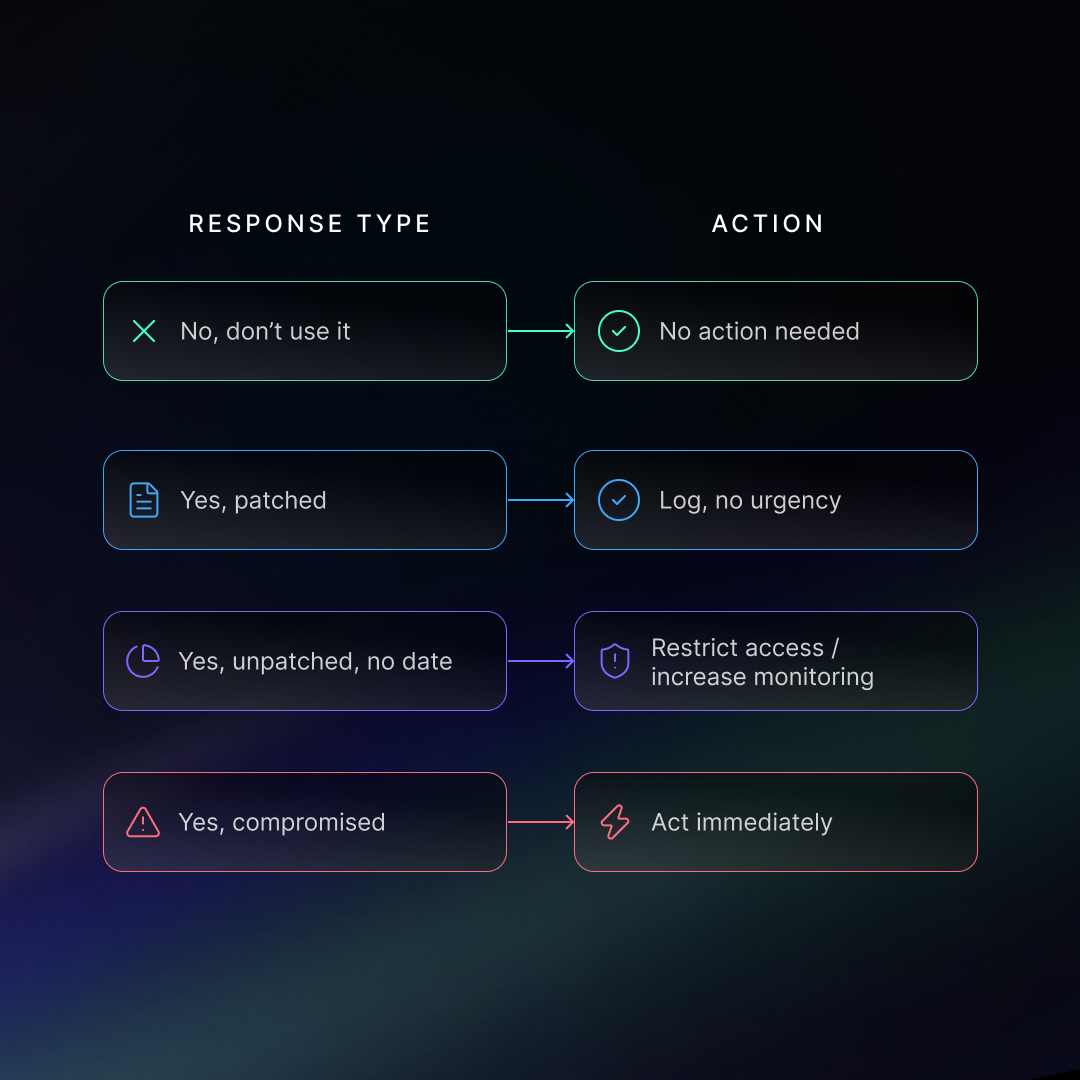
The three answers point to different next steps, and the response itself decides which one applies.
A supplier confirming they don't use the affected technology needs no further action. That's the outcome you want, and it closes the question for that supplier. A supplier confirming they use it but have already patched it is a different situation again, worth logging but not urgent. The response that changes things is a supplier confirming they use it, haven't patched it, and don't have a firm date for when they will.
At that point the decision depends on more than the vulnerability itself: what this supplier does, what data they hold, and what access they have. Depending on those factors, and on how long the exposure window has been open, the options include restricting or cutting off supplier access, increasing monitoring on the connection, notifying the internal teams who own that relationship, or triggering continuity plans if the supplier might become unavailable.
Confirmed compromise changes the calculation further. A vulnerability with no evidence of exploitation is a risk to manage. A vulnerability that's already been exploited is closer to an active incident, and the case for acting immediately, even at some operational cost, gets much stronger. Waiting it out at that point risks the compromise spreading further before anyone acts on it.
None of these actions apply to every supplier that responds. They apply to the ones where the response, combined with what that supplier means to the business, actually warrants it.
A supplier saying they don't use the affected technology directly doesn't necessarily close the question. It closes it for them, not for what sits behind them.
A direct supplier might not use the affected product themselves, but one of their hosting providers, identity providers, or other dependencies might. That's where fourth-party exposure comes in: how far down the chain a threat can reach before it stops being relevant to you.
This isn't something to chase down for every supplier that gives a clean answer. It matters most for the suppliers flagged as high priority, where a "no" from the direct supplier still leaves enough at stake to ask one more question: what do you depend on, and could any of that be affected instead?
What Hidden Supplier Dependencies Could Increase Our Risk? covers this in full.
None of this works if it has to be built while the threat is already live. Knowing which suppliers are critical, which hold sensitive data, and how to reach them all has to already exist before an incident starts, not get assembled in the middle of one.
That's not a criticism of any particular team. It's simply that a scramble is the worst possible time to build a supplier map from scratch. The organisations that handle this well aren't the ones with the most complete picture of every supplier they've ever worked with, they're the ones who did the groundwork long before they needed it, so that when a threat does land, the only decision left is who to contact and what to ask.
This is also why, at Risk Ledger, we don't treat emerging-threat response as a separate exercise bolted onto a supply chain programme. The supplier data, criticality, and contact routes needed to prioritise outreach are already current as part of how the platform runs day to day. Our customers don't do anything extra to get this. It's there when they need it, not something they build in a hurry.
These events don't happen often. But when one does, the difference between a targeted response and a blanket email to every supplier usually comes down to work that was done months earlier, not anything done in the moment.
Assess how much visibility you currently have into supplier criticality, dependencies and contact routes, and where the gaps could slow you down when the next one lands.
Take the Supply Chain Exposure Assessment →



Monthly research, case studies and practical guides you won't find anywhere else.
Join thousands of security managers turning their TPRM programmes into success stories.

.svg)