August 21, 2026
・
12
mins read
.png)
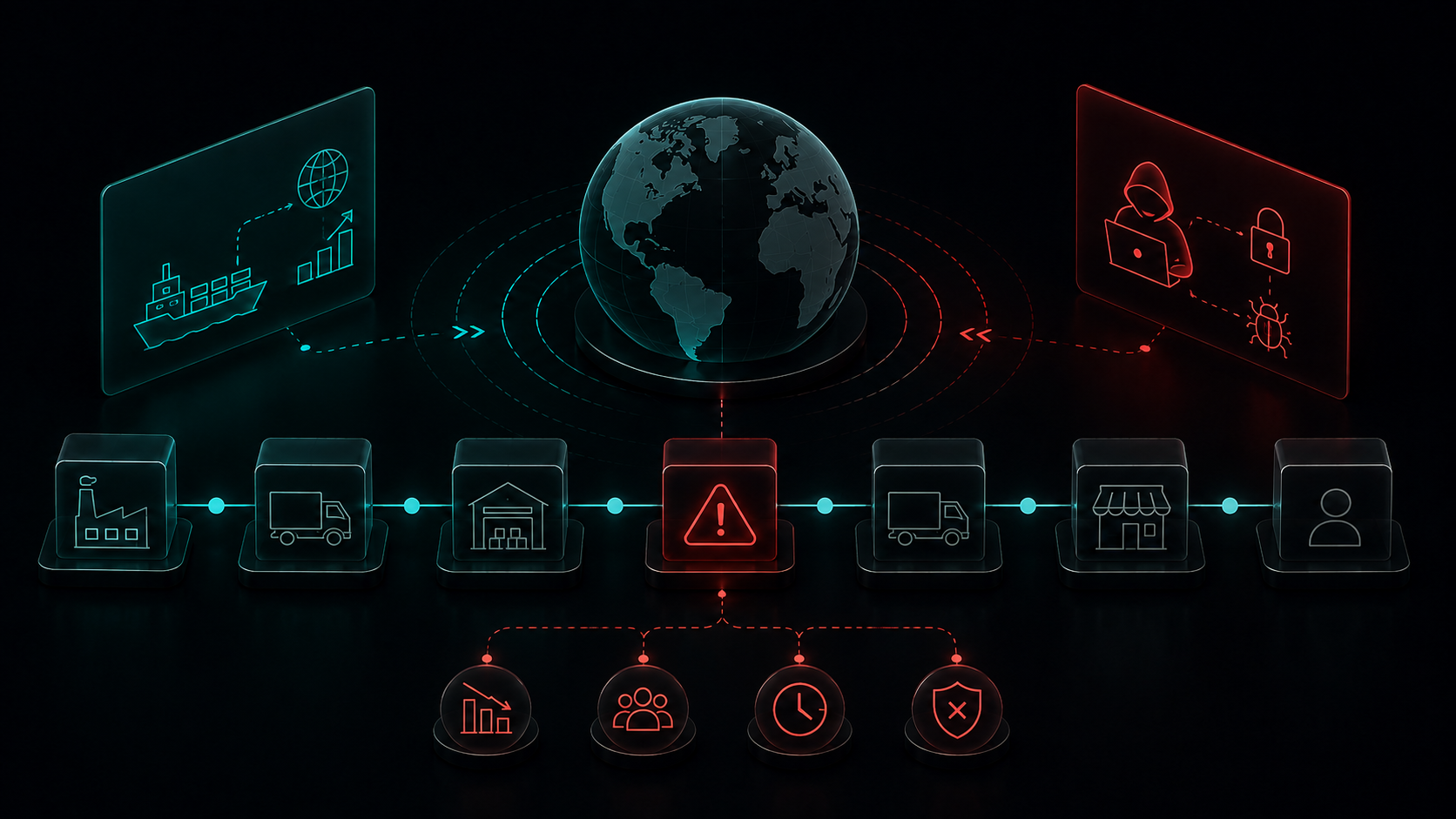
A supply chain attack is the compromise of an organisation through a trusted supplier: a software provider, a managed service, a logistics platform or any third party granted access to systems, data or infrastructure. Most reporting treats these events as contained cyber security incidents.
The pattern of recent attacks supports a wider reading. Supply chain attacks have become instruments of geopolitical competition and economic pressure, aimed at the interconnected ecosystems that underpin trade, infrastructure and public services. Attackers concentrate on trusted suppliers because one successful compromise can grant them access to multiple downstream customers of that supplier at once. Third-party risk management that is built on periodic questionnaires was never designed to detect campaigns and impacts of that nature, and this discrepancy is getting worse with each passing year.
Nation states, organised criminal groups and politically motivated actors frequently use supplier compromises to achieve strategic outcomes without having to directly attack more hardened enterprise defences. European threat reporting through 2025 documented state-aligned groups conducting long-term espionage against the telecommunications, logistics, and manufacturing sectors in particular. Operating through third-party suppliers as initial entry points, these campaigns relied on software supply chain attacks, evasive post-compromise toolkits, and cryptographic signature abuse to bypass endpoint controls.
Security leaders are acutely aware of this shift. The World Economic Forum's Global Cybersecurity Outlook 2026 reports that geopolitics remains the top factor shaping cyber risk mitigation strategies, with 91% of the largest organisations having changed their cyber security strategies in response to geopolitical volatility. Yet spending more on defence does not necessarily equate to better protection. Budgets flow into perimeter controls while adversaries move through trusted connections that those controls can't keep safe.
A typical enterprise depends on hundreds or thousands of suppliers, each holding credentials, integrations or handling data flows into and out of the organisation. Every one of those relationships is a pathway. The same WEF survey found 65% of large companies now rank third-party and supply chain vulnerabilities as their greatest resilience challenge, up from 54% a year earlier. Attackers read that exposure the same way defenders do, and they price it accordingly.
The dynamics at work are straightforward. Breaching one heavily defended bank requires sustained effort against mature controls, a security operations centre and an incident response capability. Compromising a smaller software supplier that serves 500 banks requires one intrusion to then be able to exploit the access this offers to multiple customer environments.
The Verizon 2025 Data Breach Investigations Report found that third-party involvement in breaches doubled to 30% of all cases in a single year. That doubling occurred while security teams continued assessing suppliers one questionnaire at a time. TPRM programmes measured in assessments completed cannot keep pace, however, with adversaries who measure success in penetrated ecosystems.
Software suppliers, managed service providers and cloud platforms act as force multipliers. One malicious update, one stolen administrative credential or one poisoned dependency propagates to every organisation that trusts the source.
Recent incidents demonstrate that they focus on suppliers sitting at chokepoints of interconnected ecosystems, a pattern visible in the incidents tracked through Risk Ledger's Emerging Threats reporting. The September 2025 ransomware attack on Collins Aerospace's MUSE check-in platform disrupted operations at Heathrow, Brussels and Berlin simultaneously, forcing manual processing and cancelling dozens of flights across three countries in a single weekend. One supplier, one intrusion, continental disruption.
Organisations grant suppliers privileged access by design. Deployment pipelines accept their updates, networks accept their credentials and business processes depend on their availability. Security architectures assume supplier legitimacy, which converts every such trusted relationship into a potential entry point.The ENISA Threat Landscape 2025 reports a surge in threat actors abusing these cyber dependencies precisely because interconnectedness magnifies the impact of each attack.
A compromised supplier looks identical to a healthy one. Its updates are signed, its credentials are valid and its traffic matches established patterns. Customers learn of the compromise when the attacker acts on them, sometimes months after the initial intrusion in many documented cases, and long after any full assessments or re-assessments had been conducted.
Direct suppliers depend on their own suppliers, and visibility rarely extends past the first tier. A hosting provider four steps removed can carry the same blast radius as a contracted supplier, yet appears in no assessment. These unmonitored fourth-party dependencies can concentrate risk invisibly. When many organisations rely on the same hidden provider, a single compromise becomes a sector-wide event, and concentration risk remains outside the scope of traditional assessment models entirely.
Most TPRM programmes still operate on annual or onboarding-only questionnaires. Risk conditions in the supplier base change daily. A completed assessment describes a supplier's control environment at the moment of submission, and the point-in-time model degrades from that moment onward. By the time responses are reviewed and approved, the posture they describe may no longer exist.
Exploits now weaponise disclosed vulnerabilities within days. Assessment cycles run in months or years. Everything that happens between those two moments in time, which is where most supplier risk materialises, goes unrecorded.
Many programmes measure completion rates: questionnaires issued, responses received, files closed. Those metrics prove the current realities as insufficient. They say little about the overall exposure risk. A supplier can hold a completed assessment and be a victim of an active intrusion at the same time.
Boards increasingly expect current cyber risk intelligence on their organisation's supply chain exposure. Security leaders briefing board based on assessment data that is eight months old cannot provide it. The result is reporting that describes a historical position while decisions demand an up-to-date one.
What would cyber supply chain risk management look like if it were designed for the threat environment described above? It would treat security as an ecosystem discipline, with visibility across direct suppliers, their dependencies and the interconnected network that links them, and it would operate continuously.
Traditional TPRM was a rational response to a much slower environment, when supplier estates were smaller and attacks propagated less quickly. The operating model has been outgrown by the conditions it was built to manage.
Active Supply Chain Security Management (ASCS) is the evolution of that model. It functions as a cyber intelligence layer across the supplier ecosystem, identifying emerging risks, detecting changes in supplier security posture, mapping interconnected dependencies and prioritising action by real-world exposure. Assessment remains part of the picture. The intelligence layer is what turns it into defence.
Continuous visibility surfaces any weakened supplier control such as a new subcontractor or an over-dependence on a critical sub-tier supplier before an attacker turns it into an incident. Response begins at the point of change instead of the point of breach.
Supply chain attacks describe the state of global competition as accurately as any trade statistic. They cluster around strategic sectors, exploit trusted relationships at scale and propagate through dependencies that static assessments never see. Organisations that continue to rely on annual reviews are defending a map of their supply chain that no longer matches the territory.
The forward path runs through ecosystem-level visibility, including nth-party dependencies and live threat patterns. Active Supply Chain Security is the discipline Risk Ledger built for that shift, moving organisations from reactive supplier assessments to proactive defence of the networks they depend on.
A supply chain attack compromises an organisation through a trusted third party, such as a software provider or managed service, using legitimate access to reach downstream customers.
One supplier compromise can grant access to hundreds of customer environments, so attackers gain greater impact for less effort than breaching a defended enterprise directly.
It is the exploitation of a legitimate supplier relationship, including signed updates, valid credentials or approved integrations, to bypass controls that assume the supplier is safe.
Supplier risk changes daily as infrastructure, subcontractors and threats shift. Annual assessments record a historical position and leave the intervening months unmonitored.
Nth-party risk is exposure transmitted through suppliers' suppliers and deeper tiers, where hidden shared dependencies create concentration risk that direct assessments never surface.
ASCS provides continuous, ecosystem-wide visibility of supplier posture and dependencies, so organisations detect and act on emerging risks before they become incidents.


Monthly research, case studies and practical guides you won't find anywhere else.
Join thousands of security managers turning their TPRM programmes into success stories.

.svg)