October 22, 2026
・
mins read
.png)

Updated 1 October 2026: added evaluation scorecard, regulation and framework guidance, public sector coverage and methodology.
Test every shortlisted vendor with one real supplier: evidence quality, supplier effort, what happens after a finding, and three-year cost.
Choosing TPRM software is not about finding the platform with the longest feature list. It's about finding an approach that fits how your team assesses suppliers, keeps evidence current and responds when risk changes.
Most platforms can organise assessments. The real test is what they change in practice: how much supplier chasing remains, how quickly you can establish exposure when an incident hits, and whether your team gets a clearer view of the suppliers and dependencies that matter most.
The point of risk management is to decide where limited time, attention and budget should go. TPRM software should make that prioritisation easier, not simply produce another score.
Third-party risk management (TPRM) software is a category of platform that helps organisations identify, assess, monitor and manage the risk that suppliers and other third parties introduce. It centralises supplier inventories, security evidence, assessments, findings and monitoring, so security, procurement and risk teams can make consistent decisions across the whole supplier relationship.
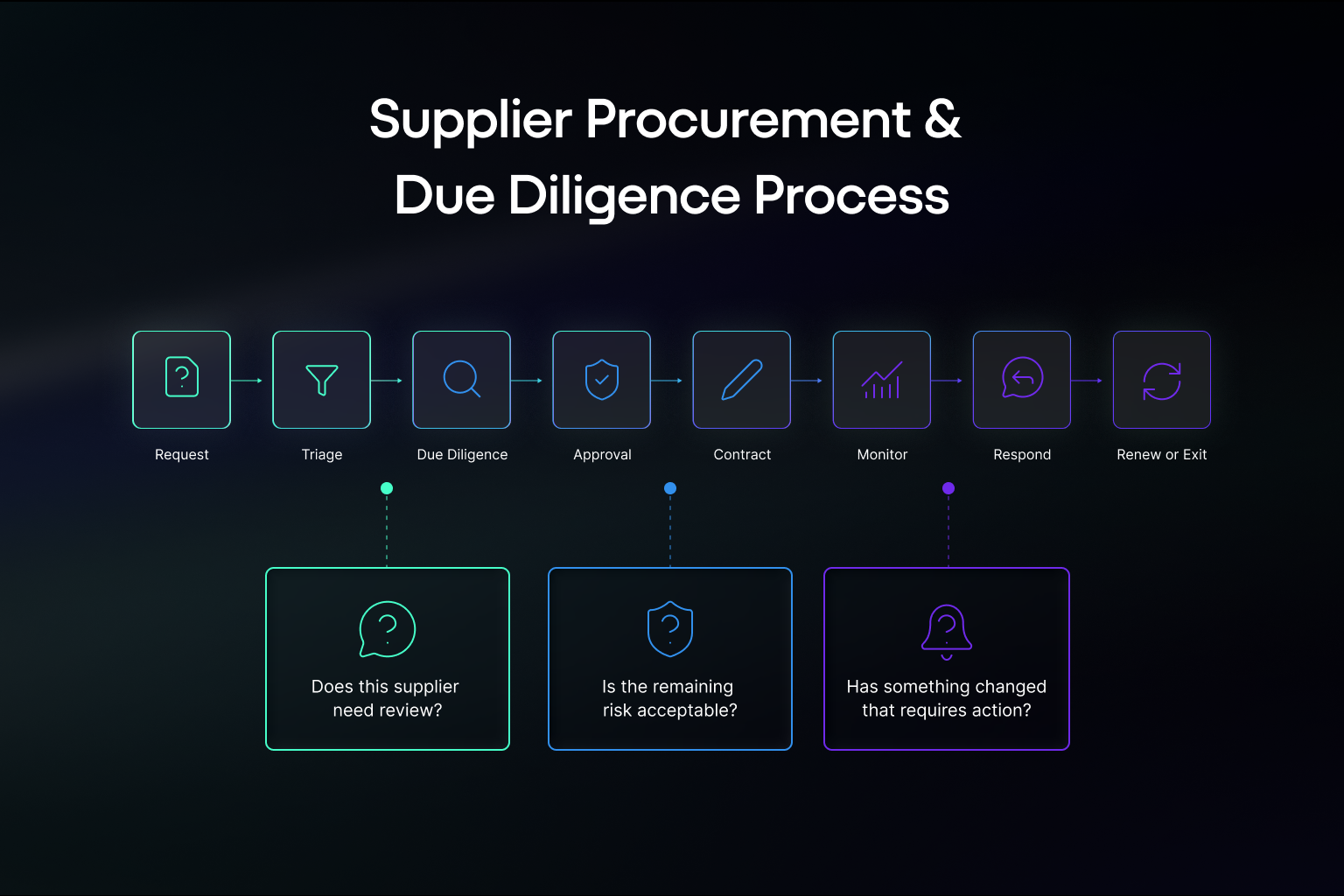
TPRM software supports a set of recurring jobs across that relationship.
Throughout, it produces the reporting that risk owners, auditors and regulators expect, and more advanced platforms also show the nth-party dependencies behind direct suppliers. A platform that only covers the first two stages digitises onboarding. The value of the category comes from carrying the same supplier context through the full lifecycle.
Security, third-party risk, procurement, GRC, compliance, privacy and internal audit teams all use TPRM software, often in the same organisation. The primary owner usually shapes the shortlist.
TPRM software and TPRM tools usually mean the same thing: platforms for managing the security risk that suppliers and other third parties introduce.
Supplier risk management software is the broader category, covering financial, operational, ESG and geopolitical risk alongside cyber. Third-party risk assessment tools handle one stage of the job, and vendor risk management overlaps with TPRM almost entirely.
The terms matter because they put different products on the shortlist:
If your business needs financial, ESG and geopolitical risk in one system, evaluate broader supplier risk management platforms separately, and expect to pair them with a security-led process.
Vendor risk management (VRM) is largely a naming choice. Many platforms use VRM and TPRM for the same product, so treat the label as a search term rather than a difference in capability. Ownership is a better guide than terminology. When procurement leads the purchase, broader supplier risk platforms tend to appear on the shortlist. And when security leads, TPRM software usually does.
TPRM software should remove repeated work, keep supplier evidence current and help the team act when risk changes. A platform that only digitises questionnaires and supplier registers makes the process tidier, but the decisions coming out of it are no better than before.
Most TPRM tools can send an assessment, store a document and produce a dashboard. That is the baseline, and it tells you little. The useful distinction is between platforms that improve how the existing process is administered and platforms that change the work the process depends on.
Admin gains are real: fewer spreadsheets, clearer ownership, an audit trail. But if suppliers still answer a fresh questionnaire for every customer, evidence still goes stale between annual reviews, and an incident still means emailing every supplier to ask whether they're affected, the team's workload has moved rather than shrunk.
Buyers tend to put this more plainly during evaluations. The questions that come up repeatedly are whether suppliers will actually fill it out, what still falls to the team after go-live, and whether the platform can show which suppliers are affected when something breaks. Those three questions are a better shortlisting test than any feature list.
Questionnaires still have a role. They provide evidence about controls that can't be observed from outside, and both NIST and the NCSC treat supplier questions as a legitimate assurance mechanism. The NCSC is also clear about the limits: answers represent a point in time, and the process is resource-intensive for suppliers and buyers alike. The problem is repeated one-to-one collection, inconsistent formats and answers treated as current long after the supplier's position may have changed.
Take one real supplier and ask each vendor to show:
Count the manual hand-offs and note who owns each step. If the demonstration ends at a score or dashboard, ask what happens next.
Software has limits here. If nobody owns supplier criticality or risk acceptance, a platform will make that missing ownership more visible but won't resolve it. And because headcount rarely grows as fast as the supplier population, the test of any platform is whether it creates time for analysis or just gives the same workload a new home.
TPRM software should sit wherever supplier-risk decisions are being made. That usually starts before onboarding, but it shouldn’t stop once the contract is signed. The same supplier context needs to carry through due diligence, approval, monitoring, incident response and renewal.
In reality, security is not always involved at the start.
Sometimes a supplier reaches the team before a commercial decision has been made. Sometimes the preferred option is already clear and the review is there to work out whether the risk is acceptable.
Both happen. The later the review starts, the less room there is to change direction if something material comes up.
A typical lifecycle looks like this:
The value comes from joining those stages up.
A finding during due diligence may need to become a contract requirement. A change in evidence may need another review. An incident may require the team to work out which service depends on the supplier and who owns the relationship.
That doesn’t mean the TPRM platform needs to replace procurement, GRC, contract management or security operations. It means the hand-offs need to work.
Ask the vendor to take one supplier from initial request through approval, monitoring and incident response.
Pay attention to where information carries forward and where somebody still has to copy it into another system. Check what triggers reassessment, who owns each decision and whether the business context stays attached to the supplier.
The test is simple: does the platform help the organisation manage one connected supplier relationship, or several separate records that happen to use the same company name?
Most TPRM tools fall into five types: enterprise governance suites, TPRM workflow platforms, ratings and monitoring platforms, evidence and compliance platforms, and network-led TPRM platforms. They overlap at the edges, but each has a different centre of gravity. That shapes the evidence you get, the work suppliers do and how much administration stays with your team.
Products blur these lines. A workflow platform may ingest ratings, a ratings provider may add questionnaires, and a governance suite may offer managed assessments. The point is to identify where each product is strongest and test what it leaves behind, not to force it into one box.
Enterprise governance suites manage third-party risk as one module inside a wider GRC, IRM or procurement system. They're strongest when consolidation is the goal and one system of record across audit, privacy, procurement and enterprise risk matters most. The trade-off is depth and effort: implementation and administration can be heavy, and supplier-security assessment may be one module among many.
What to test: how much configuration the TPRM module needs, what suppliers see, and whether the evidence is richer than email would give you.
TPRM workflow platforms run the end-to-end assessment lifecycle as their core product, from intake and tiering through questionnaires, findings, remediation and renewal. They suit mature programmes with dedicated administrators and bespoke, weighted methodologies. The trade-off is that they can make the questionnaire model more efficient without changing it, and flexibility becomes maintenance.
What to test: time to useful supplier coverage, and who maintains questionnaires and scoring after launch.
Ratings and monitoring platforms observe suppliers from outside, scoring internet-facing assets, vulnerabilities and configuration across large portfolios. They're strongest for rapid, low-effort coverage of thousands of suppliers and alerts when something observable changes. The trade-off is what the outside can't see: internal controls, and why a supplier matters to you.
What to test: how findings are attributed and disputed, and what happens between an alert and a decision.
Evidence and compliance platforms make existing security evidence easier to collect, reuse or share, through assessment exchanges or trust and compliance platforms. They're strongest when the same evidence is requested repeatedly and faster due diligence is the priority. The trade-off is freshness and depth: evidence reflects a point in time, and customer-side remediation workflows can be lighter.
What to test: how old the evidence is when you receive it, and what happens after you spot a gap.
Network-led TPRM platforms connect customers and suppliers on a shared platform. Suppliers maintain one reusable security profile, each customer applies its own policies, and the connections show dependencies beyond direct suppliers. They're strongest when supplier chasing, duplicated assessments and concentration risk are the main problems. The trade-off is coverage and standardisation.
What to test: network coverage of your actual supplier list, and the onboarding route for suppliers not yet represented.
Two things often appear on TPRM shortlists without being types of TPRM tool.
Managed services are a delivery model. Providers run assessments, review evidence and chase suppliers on your behalf, and any of the five types can come with one. If the real constraint is people rather than process, a managed service can be better advice than new software. Ask whether you're buying software, people or both, and who holds the programme's knowledge if the service changes.
Broader supplier intelligence platforms cover financial, ESG, geopolitical and physical supply chain risk. They solve a wider problem than security-led TPRM and are worth evaluating separately if that wider problem is yours.
Choosing a TPRM operating model means matching the type of tool to the constraint that's actually limiting your programme. That constraint might be supplier chasing, stale evidence, governance, external visibility or internal capacity. Start with the hardest recurring job your team has to do, then check that the rest of the supplier lifecycle still works.
"We need better TPRM" is too broad to shortlist against, so be specific about where the process breaks. For some teams it's collecting evidence: the same questions sent to the same suppliers, answered slowly or not at all. For others it's deciding which suppliers matter, keeping assessments current, managing remediation, or working out which suppliers are exposed when a vulnerability or outage hits.
Each of these points to a different type of tool. A team buried in governance and audit requests needs something different from a team that can't get suppliers to respond. Then ask who will run the platform day to day. Someone has to onboard suppliers, review evidence, investigate alerts, manage remediation and maintain integrations. A capable platform is the wrong choice if it assumes time or specialist ownership your team doesn't have, so assess the ongoing operating load, not just the implementation project.
Across the conversations behind this guide, four triggers come up repeatedly:
The trigger shapes the shortlist more than buyers expect. A regulatory deadline favours tools that produce audit-ready evidence quickly, and a tool replacement favours low migration risk. A new mandate often brings ambition beyond what the team can yet operate, which is worth naming before the first demo.
Spreadsheet-led programmes. Spreadsheets aren't automatically wrong. For a small supplier population with a clear owner, a well-kept spreadsheet can be the right starting point. Buying a platform before you have a supplier inventory and agreed tiering often stalls. Spreadsheets become the wrong model when supplier volume, evidence freshness, regulatory expectations or incident response outgrow what the team can maintain by hand.
Growing security-led programmes. These teams are past the basics but still fighting supplier chasing, inconsistent evidence and low engagement. The priority is evidence collection, supplier experience and getting reassessment to happen on schedule, rather than adding governance to a process that isn't yet running smoothly.
Mature enterprise programmes. These need governance across business units, audit trails, configurable approval routes and integration with GRC, procurement or ticketing systems. Dependency mapping and concentration-risk analysis become genuinely useful at this stage, once the supplier inventory is reliable enough to trust the output.
Advanced programmes. These are pushing beyond point-in-time assessment towards continuous assurance, with nth-party visibility, concentration risk and emerging-threat response as the priorities.
A platform built for one stage isn't wrong for another, but the mismatch shows. A highly configurable enterprise platform can slow a small team down before it delivers value, and a lightweight tool can run out of road once audit requirements grow. Buy for where the programme is now, not where you expect it to be in two years.
A TPRM scorecard weights the criteria that matter most to your programme and scores each vendor against them, with mandatory requirements treated as pass or fail.
Weighting stops every stakeholder's wish list from counting equally, and it makes the final decision easier to defend to procurement, audit and the board. Unweighted requirement lists favour the broadest platform, because every extra feature earns a tick whether or not it touches your actual problem.
Start from the bottleneck you identified when choosing an operating model and weight those criteria most heavily. If supplier chasing is the main burden, participation should count for more than reporting. If governance across business units is the issue, the reverse applies. Separate mandatory requirements first.
A vendor that fails one is out, however well it scores elsewhere, because strength in one area can't make up for a requirement you can't operate without. Then score from evidence rather than presentations: a demo using your own suppliers, a reference call with a team of similar size, or a proof of concept. Include the people who will run the process day to day, not just the buying team. Analysts and likely administrators often spot practical problems a standard demo hides.
Point-in-time assessment checks a supplier at onboarding and at scheduled intervals. Continuous assurance keeps the evidence behind that decision current between reviews, and triggers action when something material changes. Most TPRM software now claims the second, so the more useful question to ask is which kind of "continuous" a vendor actually means.
A questionnaire answered in March describes the supplier in March. Between reviews, a supplier can change hosting provider, add a subprocessor, let a certification lapse, lose the person who owned security or sit on an unpatched vulnerability, and none of it appears until the next cycle.
That's why regulators and buyers are pushing from annual questionnaires towards ongoing assurance. It's also why the term needs pinning down, because vendors use it for very different things. For some it means daily external scans. For others it means a reminder when a document expires, or a reassessment every six months.
Each is useful, but they answer different questions, and none of them alone tells you whether a supplier's internal controls still hold today. It's a fair challenge to raise in an evaluation. In one financial services evaluation we've seen directly, the buyer's own security team questioned whether a six-monthly reattestation counted as continuous at all.
Most TPRM programmes are strongest at onboarding. The harder half is the supplier approved years ago under an older process, still delivering a critical service, whose evidence nobody has looked at since.
Guidance treats this as a distinct job. The NCSC's guidance on assessing supply chain cyber security has a separate stage for bringing existing suppliers into the approach. It recommends reviewing existing contracts at renewal, or sooner for critical suppliers.
For public bodies working to the Cyber Assessment Framework, Principle A4 asks organisations to know the extent of their supply chain, including subcontractors, and to account for supply chain incidents in their incident management. Onboarding checks alone can't demonstrate either.
Financial services faces the same expectation: DORA's Article 28 frames ICT third-party risk as something managed across the whole contractual lifecycle, from pre-contract due diligence through ongoing monitoring to exit.
Continuous doesn't mean constant. Re-reviewing every supplier every month would bury the team and the suppliers. Proportionate assurance keeps low-risk suppliers on a lighter cycle, watches critical suppliers more closely, and sets clear triggers that pull any supplier forward when something changes.
Supplier participation is part of a TPRM platform's performance, not an implementation detail. A platform with strong customer workflows still fails if suppliers struggle to join, repeat work they've already done for other customers, or have little reason to keep their information current.
"Will our suppliers actually fill this out?" is one of the first questions buyers ask, and it's the right one. Non-engagement comes up in almost every evaluation we see. It takes the form of suppliers that don't respond, vendors reachable only through a managed service provider, and large providers that decline customer-specific questionnaires outright.
The cost lands on both sides. Your team spends time chasing, while suppliers deprioritise requests, rush answers or send whatever evidence is easiest to find. The result may be a completed assessment, but not better assurance. Evidence reuse reduces that friction, provided you can still apply your own policies, criticality and review requirements.
A supplier shouldn't have to rebuild the same security profile for every customer, but you still decide whether the evidence is enough for your relationship. Commercial terms matter too. In one evaluation we've seen directly, the buyer ruled out a platform that charged suppliers to join - their reasoning was that suppliers who weren't responding for free wouldn't start once they had to pay.
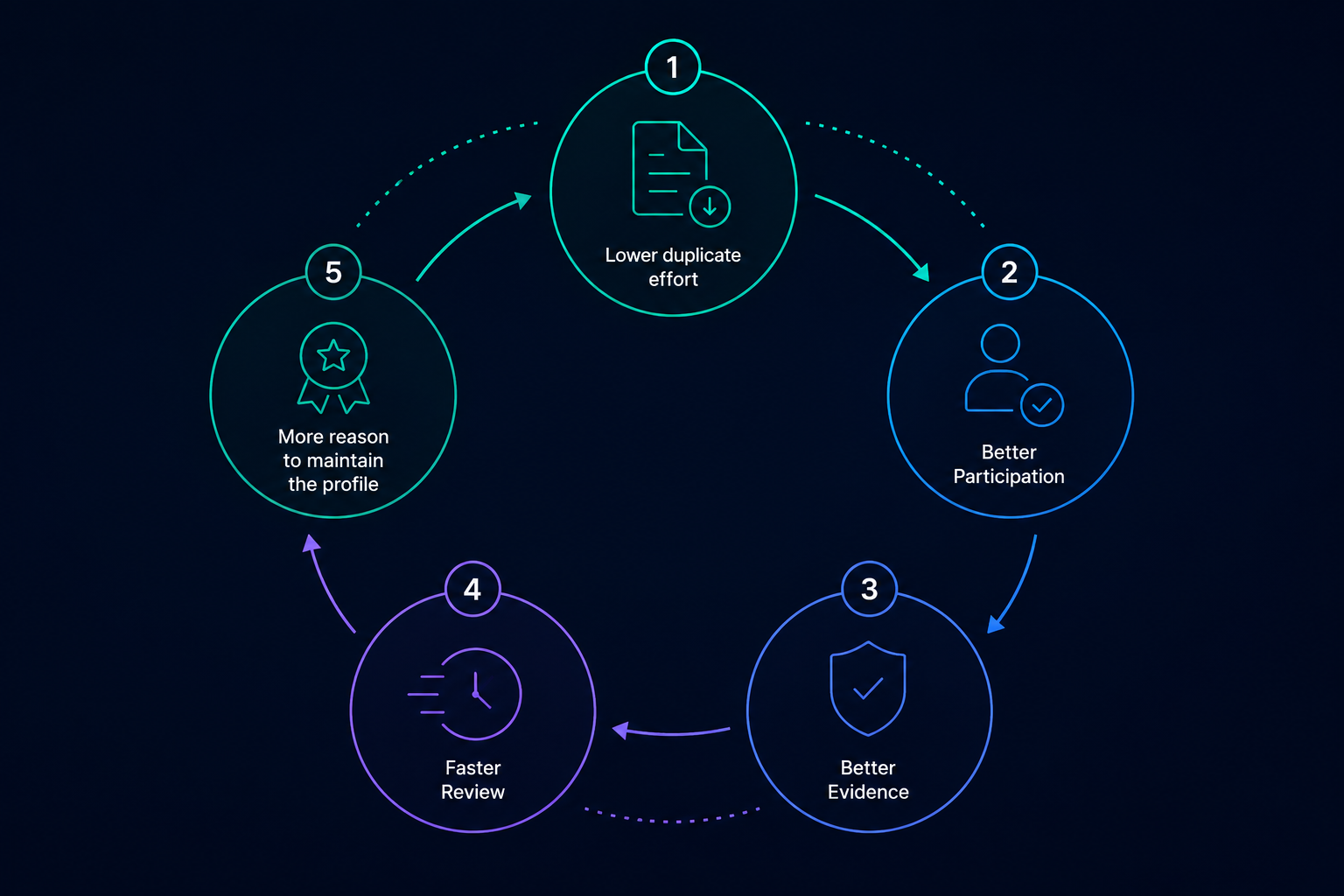
Ask each vendor to demonstrate:
For each one, look at the onboarding effort, the support available, the reminder process, whether evidence can be reused and what the fallback is. Then ask for adoption measures from customers like you: invitation acceptance, response time, profile completion, evidence freshness and reassessment completion. Supplier adoption should be measured, not assumed.
A local contractor or specialist service provider may have no security team, no certifications and nobody equipped to answer a long technical assessment, yet still hold sensitive data or access to a system you rely on. Sending them the same questionnaire as a cloud provider produces either silence or answers nobody can rely on.
Proportionate assurance tiers suppliers by potential harm, access and dependency rather than contract value, then sets a lighter route for the lowest tier. Cyber Essentials is a useful baseline here, because it gives you evidence that fundamental technical controls are in place against common, untargeted attacks. It's a floor, not a ceiling. A supplier with privileged access needs more.
Councils and government departments feel this most sharply. They combine a long tail of small local suppliers with a handful of critical technology providers, and the same supplier often receives near-identical questionnaires from several public bodies. Reusing evidence reduces that duplication, while accountability for each risk decision stays with the organisation making it. Every route also needs a fallback for suppliers that genuinely can't use the standard process, such as a short form, a call or a certification check.
Some TPRM software can show nth-party relationships, meaning your suppliers' suppliers and beyond, and the shared providers that create concentration risk across several direct suppliers. Platforms differ in where that relationship data comes from, how current it is, and whether you can use it during an incident.
Two definitions first:
A supplier register tells you who you contract with. It doesn't tell you who those suppliers depend on. The MOVEit breach in 2023 showed the difference. Many UK organisations found their staff data had been taken not because they used MOVEit themselves, but because their payroll provider did. When a shared provider fails, the useful question isn't whether a supplier is on your register. It's where your exposure sits, through whom, and which services need attention first. Answering that from a register means emailing every supplier and waiting for replies. Answering it from relationship data means filtering a list you already hold, provided that data is current. The difference is measured in days during an incident, and in credibility when the board or a regulator asks how quickly you knew.
Financial services feels this first because regulators ask for it directly. DORA requires financial entities to assess ICT concentration risk, and UK firms work under the FCA and PRA operational resilience rules, which expect them to map the third parties behind their important business services. Concentration risk is one of the reasons buyers we speak to give for moving visibility beyond direct suppliers up their list.
The public sector has its own version. In June 2024, a ransomware attack on Synnovis, a pathology provider serving several south-east London NHS trusts and GP services, disrupted blood testing and forced thousands of appointments and procedures to be postponed. One supplier, many public bodies. The same pattern applies to a department and its arm's-length bodies, or to councils in a region sharing an IT or payroll provider. Each relationship can look acceptable on its own, while the shared dependency concentrates risk across all of them.
Every supply chain map is only as complete as the relationships behind it. Visibility beyond the first tier depends on suppliers declaring who they rely on, or on external data that can be wrong or out of date, and most programmes only need it for the critical part of the supply chain. Build it once your supplier inventory and tiering are reliable, not before.
Self-assessment, security ratings and independent certification each answer a different question about a supplier, and none answers all of them. Verified evidence connects supplier-provided answers, supporting documents, external findings and the context of your relationship, so a TPRM decision rests on more than one source.
A security rating is an outside-in score of a supplier's observable cyber posture. TPRM is the wider process of assessing, deciding on and managing supplier risk, and a rating can be one input to it. Ratings are genuinely useful. They cover thousands of suppliers with no supplier effort, spot observable changes quickly and give a consistent benchmark. What they can't see is inside the organisation: whether access is reviewed, backups are tested or incident response has been rehearsed. They also can't tell that one supplier holds your customer data while another delivers stationery.
Questionnaires have the opposite strengths. They reach internal controls a scanner can't, but they rely on the supplier's word and start ageing the day they're answered. Treating either as complete assurance is the mistake. The stronger model uses each where it's strongest and checks them against each other.
When an external scan flags an exposed service, the useful next step is to link it to the supplier's answer on patching or asset management. Then ask the supplier to confirm, fix or explain it, and record the outcome. A finding that contradicts a self-assessment answer is often the most valuable signal in the whole process, because it shows where the supplier's view of itself and the observable reality differ.
Platforms vary widely here. Some place questionnaire results and ratings side by side. Fewer connect the two, let the supplier dispute a finding with evidence, and keep a record of who reviewed it and what was decided. That record matters most when you need to show an auditor or reviewer that controls were checked rather than simply declared, which public bodies working to the CAF and regulated firms both face.
Combining sources creates its own work. Someone has to review the disagreements, and a blended score can hide uncertainty rather than resolve it. If a platform offers a combined score, ask to see the inputs behind it.
TPRM software doesn't make an organisation compliant. What it can do is help you produce, maintain and retrieve the evidence your obligations require, and make the decisions behind that evidence traceable. The compliance judgement stays with your team, your regulator and your auditor.
Vendors often blur three different things:
Evidence management keeps the evidence behind those answers current, owned and retrievable. Compliance judgement decides whether the result meets the obligation. Most platforms offer the first, the strongest help with the second, and none can do the third for you. A platform that maps every question to every framework still leaves you exposed if the evidence behind the answers is two years old and nobody can say who accepted the risk.
Ask the vendor to produce, during the demo, the evidence pack for one critical supplier exactly as a regulator or reviewer would request it. That means the current assessment, its sources, open findings, accepted risks with their owners, and the history of each decision.
Framework mapping links assessment questions to obligations such as DORA or the Cyber Assessment Framework. Evidence management keeps the evidence behind those answers current, owned and retrievable. Compliance judgement decides whether the result meets the obligation. Most platforms offer the first, the strongest help with the second, and none can do the third for you. A platform that maps every question to every framework still leaves you exposed if the evidence behind the answers is two years old and nobody can say who accepted the risk. The useful test is practical. Ask the vendor to produce, during the demo, the evidence pack for one critical supplier exactly as a regulator or reviewer would request it. That means the current assessment, its sources, open findings, accepted risks with their owners, and the history of each decision.
DORA applies to EU financial entities, including the EU operations of UK groups. Article 28 treats ICT third-party risk as something managed across the whole relationship, from pre-contract due diligence through monitoring to exit, backed by a register of all ICT contractual arrangements. Article 29 adds an assessment of ICT concentration risk.
FCA and PRA operational resilience rules (PS21/3) have been fully in force since the transition period ended on 31 March 2025. Firms must map the people, processes, technology, facilities and information behind each important business service, including third parties. The FCA is explicit that if a third party causes a firm to breach an impact tolerance, the breach is the firm's responsibility.
Material third-party reporting comes next. The FCA's PS26/2 and the PRA's PS7/26 come into force on 18 March 2027. Firms will have to notify the regulators when they enter into or significantly change a material third-party arrangement, and maintain and annually submit registers of those arrangements. The FCA has said this register data will also help regulators identify future critical third parties, the large providers overseen directly under a separate regime.
The Cyber Assessment Framework (CAF) reached version 4.0 in August 2025. Principle A4 covers supply chain. Its good-practice indicators include knowing the extent of the supply chain behind your essential functions, including subcontractors, and making sure your incident management accounts for incidents that start in the supply chain.
GovAssure is the government's scheme for assessing critical systems against the CAF. Government organisations must use it for OFFICIAL systems considered government-sector critical national infrastructure, and lead departments support their arm's-length bodies through the process. Most organisations also undergo an independent assurance review, which assesses supply chain outcomes alongside the rest of the CAF.
Supply chain scrutiny is increasing. The government's digital roadmap sets December 2026 as the point when foundations to strengthen supply chain security should be in place. It describes clearer mapping of government supply chains and enforced baseline security standards. For public bodies, the practical requirement is audit-ready evidence that supplier controls were checked, not just declared. That means named owners, remediation history and decisions that can be retrieved when a reviewer asks.
A finding is where TPRM software either earns its keep or becomes a reporting tool. The platform should give every finding an owner, a deadline and a route to remediation or documented risk acceptance. It should then pass the outcome into procurement, GRC and ticketing systems without anyone re-keying it.
Supplier risk runs across teams that rarely share a system. Procurement may sign a supplier before security is involved, and a late review leaves less room to change course. And a finding at due diligence may need to become a contract clause, an exception may need GRC approval, and an incident may require working out which service depends on the supplier, something nobody recorded at onboarding.
Each hand-off is a chance to lose context. A finding emailed to procurement arrives without its evidence, and a risk accepted in one system expires unnoticed in another.
TPRM software doesn't need to replace your procurement or GRC platform to fix this. It needs to make the hand-offs reliable, so the same supplier context travels with each decision. The test is simple - follow one supplier from request to renewal and ask whether you're looking at one connected relationship, or several separate records that happen to share a company name.
Integration lists are long and mostly beside the point. The integrations that matter connect the start of a supplier relationship to the decisions made about it:
Asset and identity inventories help link suppliers to the systems and data they touch. Ask to see each integration working end to end in the demo, using your own field names, rather than as a logo on a slide. An API means an integration project is possible. It doesn't mean the integration already exists.
Completed assessments measure effort. Boards and regulators ask a different question: which critical suppliers are covered, where material exposure sits, and which risks have been accepted, by whom and until when.
Different audiences need different views of the same evidence:
Every figure should trace back to the evidence behind it. Buyers often need this reporting to build the internal business case in the first place, so test it early, not after go-live.
Groups add a governance layer. A government department and its arm's-length bodies often share suppliers while each organisation stays accountable for its own risk decisions, and the same is true of a regional group of councils. GovAssure reflects this structure, with lead departments supporting their arm's-length bodies through the process.
The platform question is whether a central team can set policy and see concentration across the group while each entity keeps its own assessments, risk appetite and decisions. Test permissions, escalation routes and group-level reporting. Check that reusing one entity's assurance doesn't quietly transfer accountability to it. The same model may suit financial services groups with several regulated subsidiaries, though it's a less established pattern there than in central government.
The real cost of TPRM software is the licence plus everything the platform leaves your team to do: implementation, integrations, data feeds, services, supplier chasing, evidence review and alert triage. Compare three-year operating cost and time to useful supplier coverage, not the subscription price.
The cheapest subscription can be the most expensive programme. A low-cost tool that leaves your team sending questionnaires, chasing suppliers and reconciling evidence by hand moves cost from the invoice to your headcount, and headcount is what most security teams are shortest of. Pricing models also vary by type.
Governance suites tend to price by module and user, ratings platforms by the number of organisations monitored, and workflow platforms by supplier volume, with managed assessments on top. Some models also charge suppliers, which affects participation as much as budget. Each of these models is reasonable, but they scale differently.
A platform priced per monitored supplier gets more expensive exactly as your coverage improves. Ask each vendor to price your actual supplier population across three years, including services and the tier you'll need in year two. Set that price against the internal time the platform will remove and the time it won't.
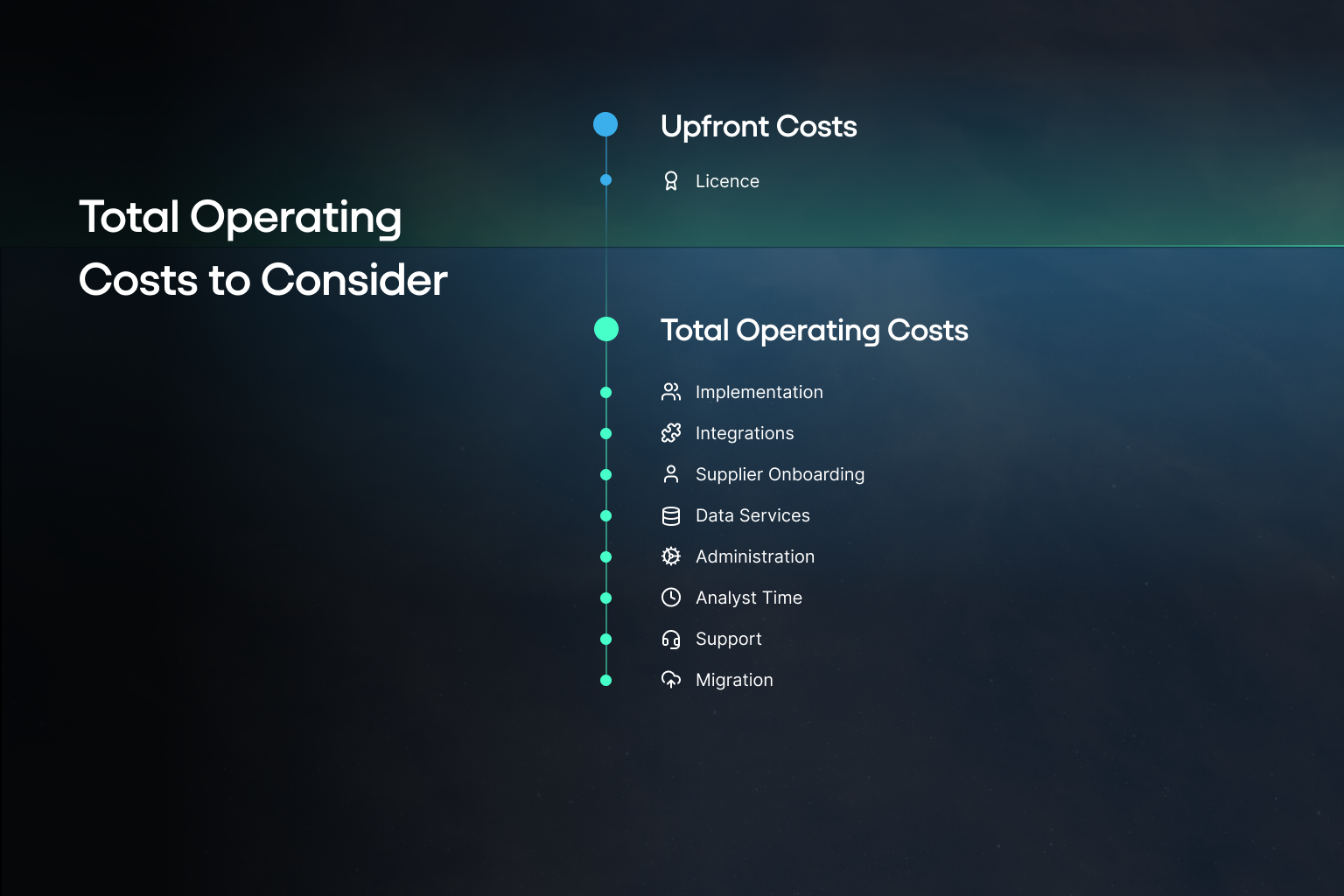
Implementation plans usually measure configuration: the platform is set up, users are trained and questionnaires are loaded. Value starts later, when priority suppliers are actually covered with current evidence. How long that takes depends mostly on supplier participation and on how much usable evidence already exists, not on the platform's setup checklist.
Ask for a week-by-week plan that names the date your critical suppliers will be assessed, who does the work in each week, and what happens to suppliers who haven't responded by then. A quote that only covers configuration is half a plan.
A higher licence fee can still be the cheaper programme if it removes enough internal work. That's why the comparison has to cover three years and include your team's time.
Every type of TPRM software trades one strength for another: configurability against upkeep, breadth against depth, scale against evidence quality. The right choice depends on which side of each trade-off your programme can live with. Naming those trade-offs early saves time later in the evaluation.
Vendor comparisons tend to present capabilities as if they add up but, in practice, they pull against each other. A platform that lets you build any questionnaire and scoring model you like also needs someone to maintain them. It also makes results harder to compare across suppliers, and harder for suppliers to reuse. And a platform that standardises everything is quicker to run and easier for suppliers, but may not satisfy a bespoke control framework.
Neither is better in general. Decide in advance which side of each trade-off you're prepared to accept, and write it into the requirements. That way the evaluation team isn't swayed by whichever demo shows the most impressive version of the side you didn't need. Trade-offs also shift as a programme matures, so revisit them at renewal rather than assuming the first answer still holds.
The most useful questions for a TPRM vendor test what happens beyond the demo: where evidence comes from, how suppliers participate, what "continuous" means, what happens after a finding and what the platform will cost over three years. Weak answers tend to sound confident and general, so ask vendors to show rather than tell.
Use the same questions with every vendor, and send them in writing before the demo so the session shows the answers rather than describing them. Score each answer against your weighted criteria, not against how polished the presentation was. Where a vendor can't answer, record it as a gap rather than a "to follow", because follow-ups have a way of never arriving before the contract does.
The weak answers listed below don't prove a platform is wrong for you. They're prompts for a follow-up question, to see whether the vendor can get specific. A vendor that answers "it depends" and then explains exactly what it depends on is usually giving you a better answer than one with a confident yes to everything. Bring the people who will run the process into these sessions too, since they'll recognise a vague answer about supplier chasing or alert triage faster than the buying team will.
A proof of concept should use your suppliers, not the vendor's sample data. Include a critical supplier, a small one and one that's slow to respond, and measure what changes: how long coverage takes, how much your team had to do, and what the suppliers thought of the experience. A short pilot with real suppliers tells you more than a longer series of polished demos.
For references, ask for a customer of similar size and sector that has been live for more than a year. Ask what they'd do differently, what still takes more time than expected, and whether supplier participation matched what they were promised.
There is no universally best TPRM software. Governance-led organisations are usually best served by a governance suite, security teams monitoring very large portfolios by a ratings platform, and mature programmes with bespoke methodologies by a configurable workflow platform. Teams whose hardest problems are repeated supplier requests, participation and visibility beyond direct suppliers should start with a network-led platform.
If the main requirement is enterprise governance, start with a governance suite, and accept that supplier-security depth may need a specialist platform feeding into it. If it's broad outside-in monitoring, start with a ratings platform and plan how critical suppliers will get deeper evidence.
If a dedicated team runs a detailed, bespoke assessment methodology, a configurable workflow platform will fit that methodology best. If the job is mainly sharing and reusing compliance evidence, an evidence and compliance platform may be all you need for now. If there's nobody to run the programme, a managed service is often better advice than any software.
And if the central problems are repeated supplier requests, low participation, stale internal-control evidence and slow exposure analysis when an incident hits, a network-led platform belongs at the top of the shortlist. Risk Ledger builds this last model.
Most mature programmes end up combining two of these, usually a system of record and a specialist layer. Which pair you choose matters less than being clear which tool owns which job, so evidence, findings and decisions don't end up split across systems that nobody reconciles.
Risk Ledger is a network-led TPRM platform for security teams. Suppliers maintain one standardised security profile and share it with each customer who needs it. Every customer applies its own policies and risk appetite to that evidence, and the connections between organisations show dependencies beyond direct suppliers.
We built Risk Ledger around one observation: most of the work in a traditional TPRM programme is duplicated. The same supplier answers broadly the same questions for dozens of customers, each in a different format, and each customer chases, reviews and files the answers separately.
The evidence is out of date by the time the next cycle comes round, and none of it shows who those suppliers depend on. Better workflow software makes that process tidier but leaves the duplication in place, so we changed the evidence model instead.
A supplier completes and maintains one profile, shares it with each customer and keeps it current as things change. It's free for suppliers to take part, because charging the people you need answers from is a reliable way not to get them. Customers still make their own decisions. The profile is shared, the judgement isn't.
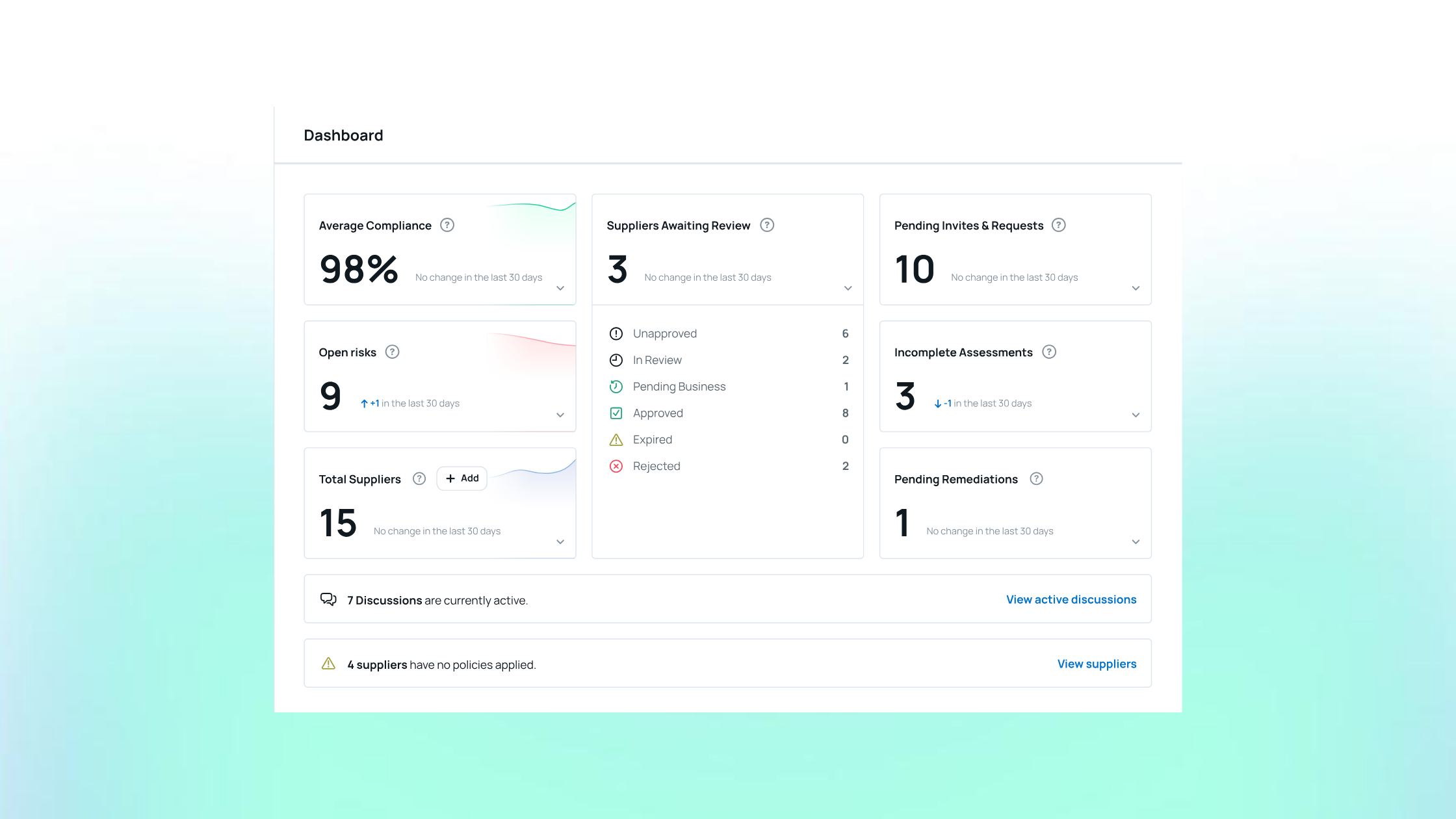
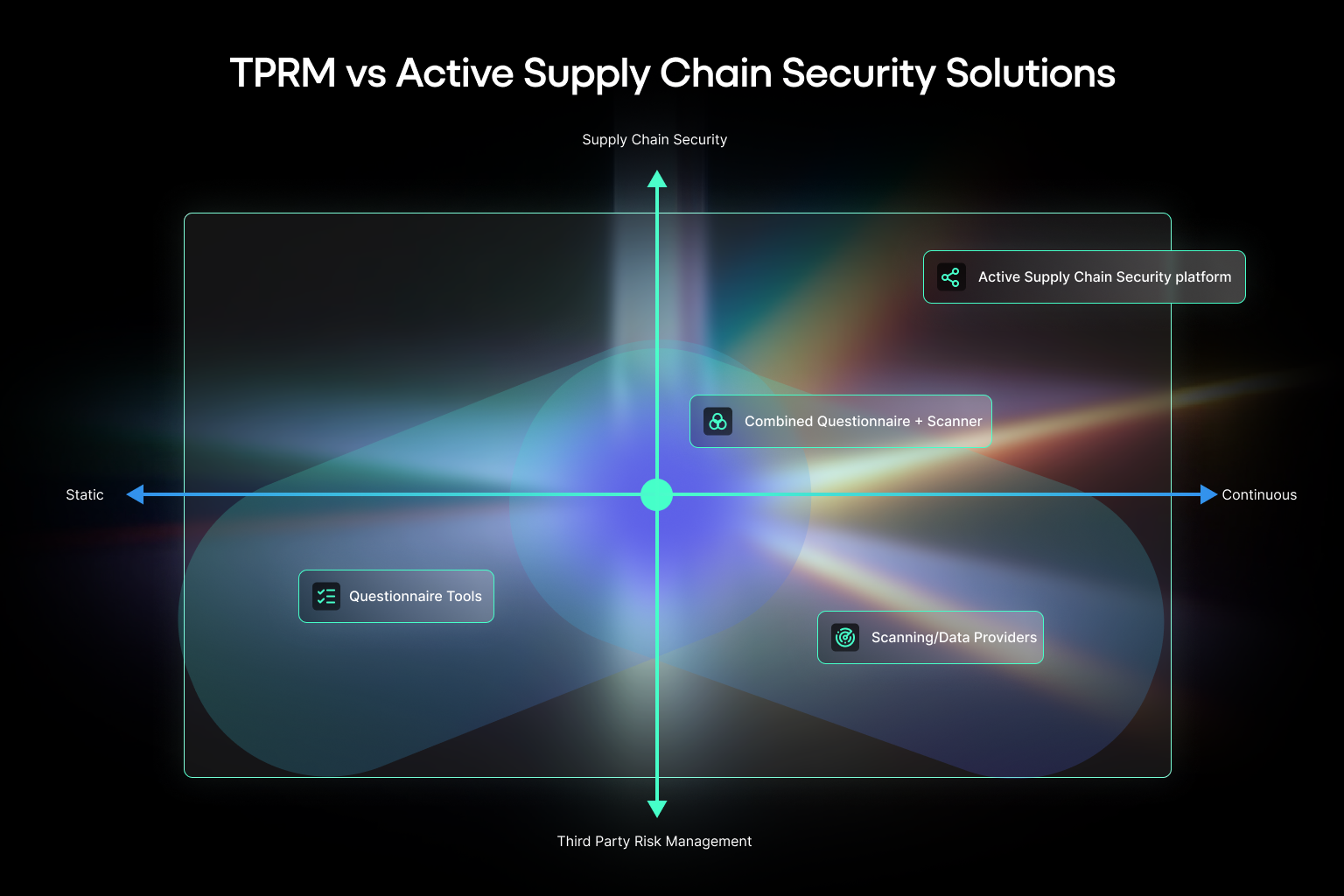
We call this approach Active Supply Chain Security. The label matters less than the mechanics behind it: reusable supplier evidence, visible dependencies and a coordinated response when a shared threat appears.
Risk Ledger is best suited to security-led teams that value supplier participation, reusable supplier evidence and visibility beyond their direct suppliers, and that want those capabilities working inside a standardised assessment process rather than a heavily configured one. Another route may fit better if:
NIST SP 800-161 Rev. 1, Cybersecurity Supply Chain Risk Management Practices for Systems and Organizations
NIST Cybersecurity Framework 2.0: Quick-Start Guide for Cybersecurity Supply Chain Risk Management
NCSC: The principles of supply chain security
NCSC: How to assess and gain confidence in your supply chain cyber security
NCSC: Supplier assurance questions
UK Government: Cyber Security Breaches Survey 2025/2026
CISA: Supply Chain Risk Management Essentials
ENISA: Good Practices for Supply Chain Cybersecurity
Gartner: Third-party risks are driving growth and maturity in TPRM technology
EY: Global Third-Party Risk Management Survey
Federal Reserve: Interagency Guidance on Third-Party Relationships
Bank of England and PRA: Outsourcing and third-party risk management

Monthly research, case studies and practical guides you won't find anywhere else.
Join thousands of security managers turning their TPRM programmes into success stories.


.svg)